Emergency Services FAQs

Traffic Safety Spotlight – Emergency Services FAQs
When emergency vehicles and first responders are working along our roadways, every driver plays a role in keeping the scene safe. Knowing when to pull over, move over, slow down, and create space helps protect law enforcement, fire rescue, emergency medical services, Road Rangers, crash victims, and everyone traveling nearby.

Sharing the Road with Emergency Responders

Our Emergency Services Safety Spotlight FAQs answer common questions about sharing the road with emergency vehicles. We’ve highlighted Florida’s Move Over Law, navigating active incident scenes, and the safe driving choices that can help prevent secondary crashes.

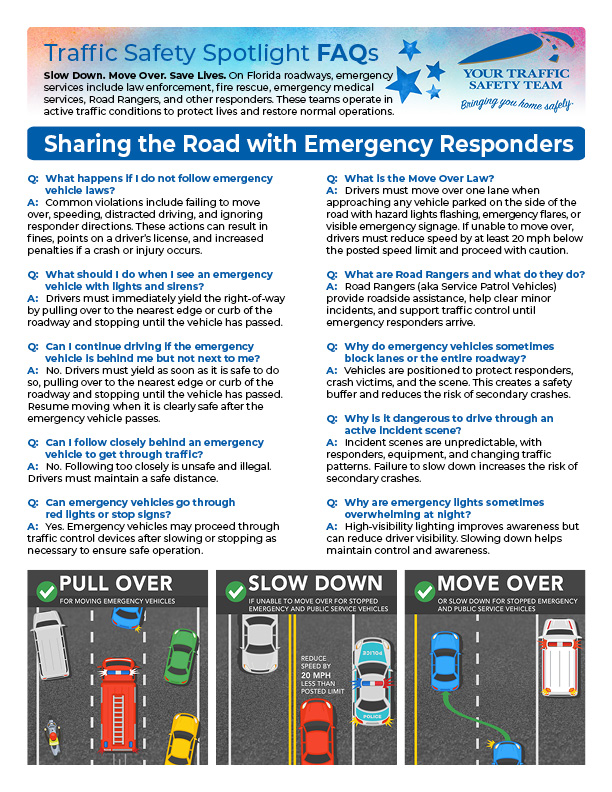
Slow Down. Move Over. Save Lives. On Florida roadways, emergency services include law enforcement, fire rescue, emergency medical services, Road Rangers, and other responders. These teams operate in active traffic conditions to protect lives and restore normal operations. 

What happens if I do not follow emergency vehicle laws?   

Common violations include failing to move over, speeding, distracted driving, and ignoring responder directions. These actions can result in fines, points on a driver’s license, and increased penalties if a crash or injury occurs. 

What should I do when I see an emergency vehicle with lights and sirens?  

Drivers must immediately yield the right-of-way by pulling over to the nearest edge or curb of the roadway and stopping until the vehicle has passed.

Can I continue driving if the emergency vehicle is behind me but not next to me?   

No. Drivers must yield as soon as it is safe to do so, pulling over to the nearest edge or curb of the roadway and stopping until the vehicle has passed.  Resume moving when it is clearly safe after the emergency vehicle passes.

Can I follow closely behind an emergency vehicle to get through traffic?    

No. Following too closely is unsafe and illegal. Drivers must maintain a safe distance.

Can emergency vehicles go through red lights or stop signs?  

Yes. Emergency vehicles may proceed through traffic control devices after slowing or stopping as necessary to ensure safe operation.

What is the Move Over Law?   

Drivers must move over one lane when approaching any vehicle parked on the side of the road with hazard lights flashing, emergency flares, or visible emergency signage. If unable to move over, drivers must reduce speed by at least 20 mph below the posted speed limit and proceed with caution.

What are Road Rangers, and what do they do?   

Road Rangers (aka Service Patrol Vehicles) provide roadside assistance, help clear minor incidents, and support traffic control until emergency responders arrive.

Why do emergency vehicles sometimes block lanes or the entire roadway?   

Vehicles are positioned to protect responders, crash victims, and the scene. This creates a safety buffer and reduces the risk of secondary crashes.

Why is it dangerous to drive through an active incident scene? 

Incident scenes are unpredictable, with responders, equipment, and changing traffic patterns. Failure to slow down increases the risk of secondary crashes.

Why are emergency lights sometimes overwhelming at night?   

High-visibility lighting improves awareness but can reduce driver visibility. Slowing down helps maintain control and awareness.


Learn more about Florida’s Move Over or Slow Down Law:

E-Bike Safety

Safety for Electric Bicycles, Scooters, and Unicycles

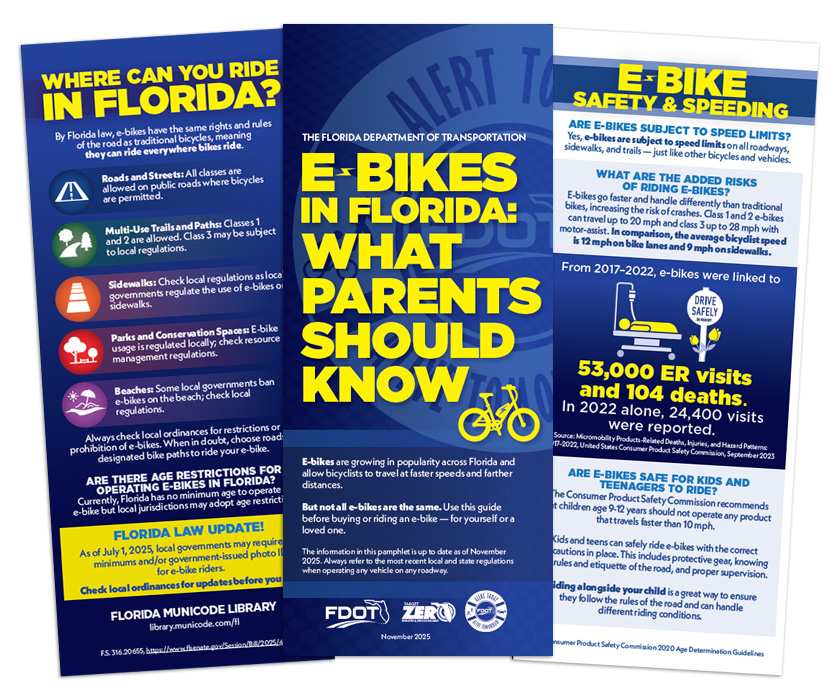
Electric bikes and e-scooters continue to grow in popularity across Northeast Florida, especially among younger riders traveling through neighborhoods and to and from school. As use increases, education and safety awareness remain a priority concern for our communities.

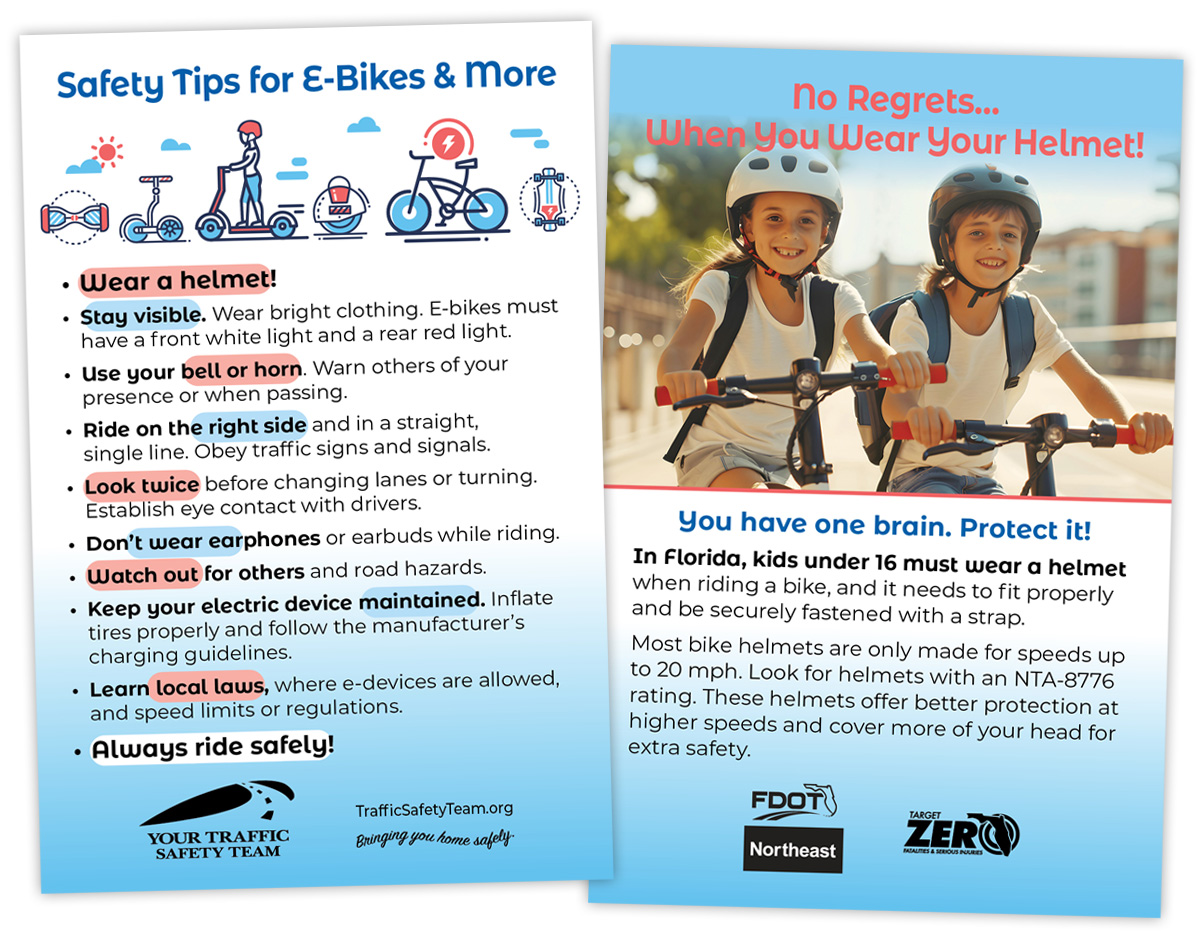
e-bike e-scooter safety tips

Below are free resources to download, print, and share. To support the outreach and education efforts of our Northeast Florida District Two Traffic Safety Team, agencies, schools, and partners, we offer our NEW folded “E-Bike + E-Scooter Safety Tips” bi-fold flyers at no cost. District Two CTST members may click here to order online, while supplies last.

Help encourage safer riding habits and smarter choices, including:
• Helmet use and visibility
• Riding responsibly and obeying traffic laws
• Slowing down around pedestrians
• Hand signals and safe passing
• Staying alert and distraction-free
• Courtesy and shared responsibility on roads, sidewalks, and shared paths

The handout encourages riders to “Ride Smart” by focusing on safe behaviors that help prevent crashes and injuries. The materials are ideal for school programs, community events, youth outreach, law enforcement education efforts, neighborhood initiatives, and safety campaigns.

E-Bike Safety Materials

We have gathered e-bike safety recommendations, tips, and guidelines. Please use and share these materials, videos, and information to help improve safety and encourage safe use of e-bikes and other micromobility devices.


Beaches E-Bike Study

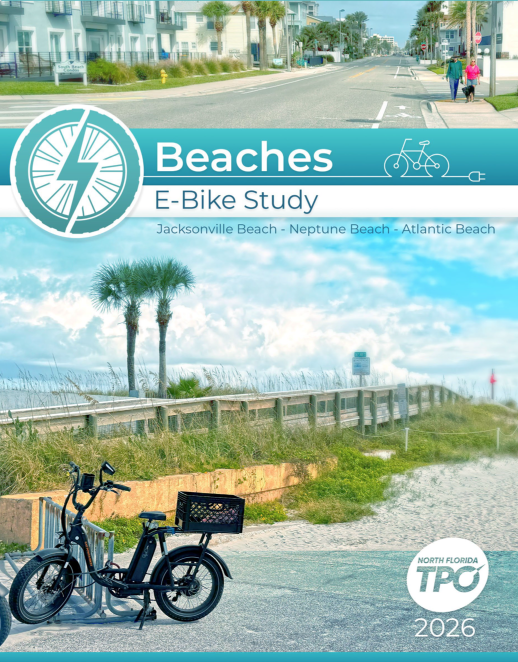
In July 2026, the North Florida Transportation Planning Organization (TPO) released this E-Bike Study for Jacksonville Beach, Neptune Beach, and Atlantic Beach. This study was undertaken in response to the local need for greater clarity, consistency, and safety regarding micromobility operations. It evaluates how E-Bikes and other forms of micromobility are currently being used throughout the Beaches municipalities, what safety issues are emerging, how existing federal, state, and local policies frame micromobility operations, and what strategies may be available to improve outcomes for riders and non-riders alike. 

This study is organized into five sections: 

  • Current Trends in E-Bike Usage
  • Existing Laws and Policies
  • Safety Analysis
  • Public Outreach
  • Recommendations

Since 2023, we have held Districtwide Discussions regarding electric micromobility devices and safety. In 2025, we hosted another e-bike safety discussion with members of our District Two Traffic Safety Team to address ongoing concerns and rising injuries. As the use of e-bikes and e-scooters continues to grow, your participation in these conversations helps shape a more informed and proactive approach to addressing emerging challenges on our roads.

With expert insights and local perspectives, member engagement made this a valuable and productive meeting. A special thank-you to our presenters: Mark Sekelsky and Brian Benwick of the North Florida Bicycle Club; Rebecca Melvin, Trauma Injury Prevention, Education and Outreach Coordinator at UF Health Jacksonville; and Jackie Morrison, Community Health Educator and Safe Kids Northeast Florida Coordinator at Wolfson Children’s Hospital.

Here are links to the presentation, which includes our presenter’s slides, along with additional resources:

We have been addressing e-bike concerns since the early 2020s. In 2022, we created a presentation on micromobility, discussing terms, usage, and safety challenges nationally and in Northeast Florida. In 2023, we held multiple district-wide meetings addressing roadway concerns and issues regarding micromobility—specifically electric bicycles, scooters, unicycles, and golf carts or low-speed vehicles. Undoubtedly, tackling these safety concerns, from educating the public to tracking e-bike/scooter/unicycle crashes, trauma injuries, and enforcing local ordinances, will take a group effort.

Senate Bill 462 – Transportation was approved by Governor Ron DeSantis. The bill [Chapter No. 2025-149] went into effect on July 1, 2025, and will give local governments the authority to adopt additional regulations related to electric bicycles.

Key provisions of SB 462 include allowing local governments to:

  • Adopt ordinances establishing minimum age requirements for operating an electric bicycle.
  • Require operators of electric bicycles to possess government-issued IDs while riding.
  • Provide training on the safe operation of e-bikes and compliance with relevant traffic laws.

Legislation filed in November 2025 was VETOED by Governor Ron DeSantis: CS/SB 382: Micromobility Device

  • Senate Bill 382 [passed by Florida Senate and House, vetoed by Governor] – Micromobility Device; Providing requirements for the operation of electric bicycles; prohibiting the operation of an electric bicycle above a certain speed under certain circumstances; creating the Micromobility Device Safety Task Force adjunct to the Department of Highway Safety and Motor Vehicles; requiring the Florida Highway Patrol and each police department and sheriff’s office to maintain a certain list, beginning on a certain date, etc.

Please take a moment to review the resources, local ordinances, Florida law, and news article links below related to e-bike safety. Check out input from CTST member Brian Benwick of the North Florida Bicycle Club. Also, please read “An Approach to E-Bike Safety” by CTST member Antonia Donnelly.

2026 Florida E-Bike Safety Ordinances, Guidelines, and News

2025 Florida E-Bike Safety Ordinances, Guidelines, and News

Reference Materials for the E-Bike/Scooter/Unicycle Safety Discussion –

Continue Reading

Bicycle FAQs

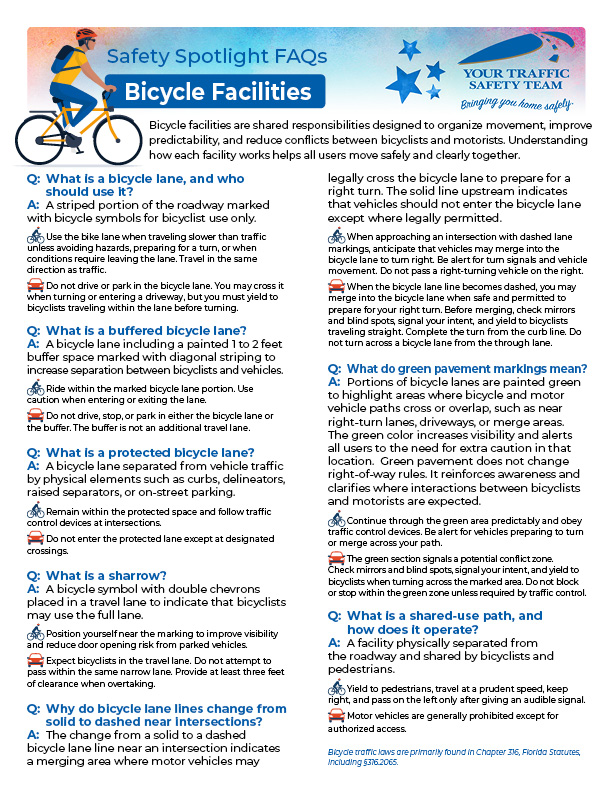
Bicycling plays an important role in creating safer, healthier, and more connected communities. As more people ride for transportation, recreation, fitness, and commuting, understanding how bicycle facilities operate and how bicyclists and motorists safely interact becomes increasingly important. Here, we are answering some common bicycle FAQs. From bicycle lanes and shared-use paths to traffic laws and intersection markings, every part of the transportation system works together to improve predictability and reduce conflicts.

Safe System Approach and Bicycle FAQs

Florida’s transportation system continues to evolve through the Safe System Approach, a traffic safety philosophy that recognizes people make mistakes and that the transportation network should help prevent those mistakes from resulting in serious injuries or fatalities. Instead of placing all responsibility on individual road users, the Safe System Approach promotes shared responsibility among engineers, planners, law enforcement, educators, policymakers, and all roadway users.

Bicycle facilities support this approach by organizing movement and increasing visibility for everyone on the road. Features such as buffered and protected bike lanes, green conflict-zone pavement markings, shared-use paths, and clearly marked merge areas help reduce confusion and improve awareness at potential conflict points. At the same time, Florida bicycle laws establish predictable rules and expectations for bicyclists and motorists alike.

Safety Spotlight FAQs: Bicycle Facilities

What is a bicycle lane, and who should use it?

A striped portion of the roadway marked with bicycle symbols for bicyclist use only.

  • Cyclists: Use the bike lane when traveling slower than traffic unless avoiding hazards, preparing for a turn, or when conditions require leaving the lane. Travel in the same direction as traffic.
  • Motorists: Do not drive or park in the bicycle lane. You may cross it when turning or entering a driveway, but you must yield to bicyclists traveling within the lane before turning.


What is a buffered bicycle lane?

A bicycle lane including a painted 1 to 2 feet buffer space marked with diagonal striping to increase separation between bicyclists and vehicles.

  • Cyclists: Ride within the marked bicycle lane portion. Use caution when entering or exiting the lane.
  • Motorists: Do not drive, stop, or park in either the bicycle lane or the buffer. The buffer is not an additional travel lane.

What is a protected bicycle lane? 

A bicycle lane separated from vehicle traffic by physical elements such as curbs, delineators, raised separators, or on-street parking.

  • Cyclists: Remain within the protected space and follow traffic control devices at intersections.
  • Motorists: Do not enter the protected lane except at designated crossings.

What is a sharrow?

A bicycle symbol with double chevrons placed in a travel lane to indicate that bicyclists may use the full lane.

  • Cyclists: Position yourself near the marking to improve visibility and reduce door opening risk from parked vehicles.
  • Motorists: Expect bicyclists in the travel lane. Do not attempt to pass within the same narrow lane. Provide at least three feet of clearance when overtaking.

Why do bicycle lane lines change from solid to dashed near intersections? 

The change from a solid to a dashed bicycle lane line near an intersection indicates a merging area where motor vehicles may legally cross the bicycle lane to prepare for a right turn. The solid line upstream indicates that vehicles should not enter the bicycle lane except where legally permitted.

  • Cyclists: When approaching an intersection with dashed lane markings, anticipate that vehicles may merge into the bicycle lane to turn right. Be alert for turn signals and vehicle movement. Do not pass a right-turning vehicle on the right.
  • Motorists: When the bicycle lane line becomes dashed, you may merge into the bicycle lane when safe and permitted to prepare for your right turn. Before merging, check mirrors and blind spots, signal your intent, and yield to bicyclists traveling straight. Complete the turn from the curb line. Do not turn across a bicycle lane from the through lane.

What do green pavement markings mean?

Portions of bicycle lanes are painted green to highlight areas where bicycle and motor vehicle paths cross or overlap, such as near right-turn lanes, driveways, or merge areas. The green color increases visibility and alerts all users to the need for extra caution in that location.  Green pavement does not change right-of-way rules. It reinforces awareness and clarifies where interactions between bicyclists and motorists are expected.

  • Cyclists: Continue through the green area predictably and obey traffic control devices. Be alert for vehicles preparing to turn or merge across your path.
  • Motorists: The green section signals a potential conflict zone. Check mirrors and blind spots, signal your intent, and yield to bicyclists when turning across the marked area. Do not block or stop within the green zone unless required by traffic control.

What is a shared-use path, and how does it operate?

A facility physically separated from the roadway and shared by bicyclists and pedestrians.

  • Cyclists: Yield to pedestrians, travel at a prudent speed, keep right, and pass on the left only after giving an audible signal.
  • Motorists: Motor vehicles are generally prohibited except for authorized access.

Safety Spotlight FAQs: Bicyclists – Rules of the Road

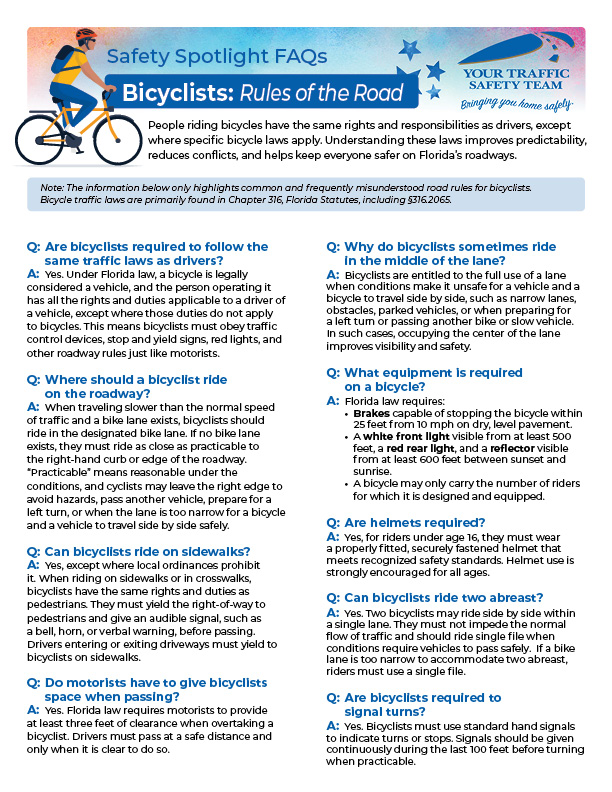
Are bicyclists required to follow the same traffic laws as drivers?

Yes. Under Florida law, a bicycle is legally considered a vehicle, and the person operating it has all the rights and duties applicable to a driver of a vehicle, except where those duties do not apply to bicycles. This means bicyclists must obey traffic control devices, stop and yield signs, red lights, and other roadway rules just like motorists. 

Where should a bicyclist ride on the roadway?

When traveling slower than the normal speed of traffic and a bike lane exists, bicyclists should ride in the designated bike lane. If no bike lane exists, they must ride as close as practicable to the right-hand curb or edge of the roadway. “Practicable” means reasonable under the conditions, and cyclists may leave the right edge to avoid hazards, pass another vehicle, prepare for a left turn, or when the lane is too narrow for a bicycle and a vehicle to travel side by side safely. 

Can bicyclists ride on sidewalks?   

Yes, except where local ordinances prohibit it. When riding on sidewalks or in crosswalks, bicyclists have the same rights and duties as pedestrians. They must yield the right-of-way to pedestrians and give an audible signal, such as a bell, horn, or verbal warning, before passing.  Drivers entering or exiting driveways must yield to bicyclists on sidewalks.

Do motorists have to give bicyclists space when passing?    

Yes. Florida law requires motorists to provide at least three feet of clearance when overtaking a bicyclist. Drivers must pass at a safe distance and only when it is clear to do so.

Why do bicyclists sometimes ride in the middle of the lane?    

Bicyclists are entitled to the full use of a lane when conditions make it unsafe for a vehicle and a bicycle to travel side by side, such as narrow lanes, obstacles, parked vehicles, or when preparing for a left turn or passing another bike or slow vehicle. In such cases, occupying the center of the lane improves visibility and safety. 

What equipment is required on a bicycle?   

Florida law requires:

  • Brakes capable of stopping the bicycle within 25 feet from 10 mph on dry, level pavement.
  • A white front light visible from at least 500 feet, a red rear light, and a reflector visible from at least 600 feet between sunset and sunrise. 
  • A bicycle may only carry the number of riders for which it is designed and equipped.

Are helmets required?  

Yes, for riders under age 16, they must wear a properly fitted, securely fastened helmet that meets recognized safety standards. Helmet use is strongly encouraged for all ages.

Can bicyclists ride two abreast?   

Yes. Two bicyclists may ride side by side within a single lane. They must not impede the normal flow of traffic and should ride single file when conditions require vehicles to pass safely.  If a bike lane is too narrow to accommodate two abreast, riders must use a single file.

Are bicyclists required to signal turns?  

Yes. Bicyclists must use standard hand signals to indicate turns or stops. Signals should be given continuously during the last 100 feet before turning when practicable.


These Frequently Asked Questions highlight common bicycle facilities, roadway rules, and safety expectations. By understanding how these facilities work and the laws, we can improve cooperation, visibility, and safety for all road users as we work together toward Florida’s Target Zero goal of eliminating fatal and serious injury crashes.

Note: The information above only highlights common and frequently misunderstood road rules for bicyclists. Bicycle traffic laws are primarily found in Chapter 316 of the Florida Statutes, including §316.2065.

Other Bicycle Traffic Safety Resources

Safety Belt Use in Northeast Florida

Florida’s statewide safety belt use rate for 2025 is 90.8 percent, an improvement from the 2024 result of 90.0 percent. This annual statewide survey is primarily designed to provide a single safety belt usage estimate for the entire State of Florida, not official county rates. However, these rates are still helpful as they serve as reference points for changes over time.

Three counties are surveyed in our 18-county FDOT District Two. Out of the 31,545 statewide total of Observed Front-Seat Occupants, including drivers and passengers, there were 4,669 observed in Alachua (1,364), Duval (1,726), and St. Johns (1,579). This accounts for 14.8% of the total number observed out of the 15 counties surveyed throughout the state.

2025 Survey Results for Safety Belt Use in Northeast Florida

  • Alachua County 91.4% (up from 90.6% in 2024)
  • Duval County 87.7 (up from 86.5% in 2024)
  • St Johns County 87.9% (up slightly from 87.5% in 2024)

Notably, the usage rates are based on weighted data from two sets of sample sites: those used in 2017-2021 and those used in recent surveys. This could influence the shift in survey numbers, and decreases could be due to the different areas where new sites are located. For example, Alachua’s usage rate was 95%, and St. Johns was 92.1% in 2021.

Despite the year-to-year fluctuation, safety belt usage generally shows an upward trend. However, the recent decline indicates that occupant protection programs should seek to increase safety belt use among the groups with disproportionately low use identified in this survey.

Occupant Protection Messages in Response to Low Usage Rates

The low safety belt usage groups identified include pickup truck occupants, male passengers, occupants between the ages of 16-34, and black occupants.

Be Savvy, Buckle Up for ages 16-34
Occupants Ages 16-34: Be Savvy… Buckle Up
Buckle up in your truck
Occupants in Pickups: Buckle Up in Your Truck

Safety Belt Law History

In 1986, Florida implemented its first adult safety belt law. Safety belt use before the law was at 22% statewide. From 1999 to 2004, Florida’s use rate increased from 59% to just over 76% due to FDOT’s “Click It or Ticket” campaign and other efforts across the state. In 2009, Florida passed a primary enforcement safety belt bill, and safety belt use has increased since the law’s passage. Working together, we can continue to increase safety belt use and reduce fatalities and injuries on our roadways.

“Always Buckle Up … for Your Family. For Yourself. For LIFE.” 
No Regrets When You BUCKLE UP!

Traffic Signal FAQs

Traffic signals are among the most visible and misunderstood elements of our transportation system. Today, we are answering some common traffic signal FAQs. While they may seem simple, traffic signals are carefully engineered tools. They are designed to reduce conflicts, manage traffic flow, and protect all roadway users, including drivers, pedestrians, and bicyclists.

Traffic signals are one component of a Safe System Approach, which recognizes that people will make mistakes and that the transportation system must be designed to anticipate those mistakes and prevent them from leading to serious injury or death. When properly designed, operated, and coordinated with other roadway and behavioral countermeasures, traffic signals help manage conflicts, control speeds, and support predictable user behavior within the broader Safe System framework.

Traffic Signal FAQs

The following Frequently Asked Questions explain how traffic signals are planned, how they operate, and why they function the way they do. Understanding these fundamentals helps explain how traffic signals fit within a multi-layered transportation system. Designed not only to move traffic efficiently but also to help everyone arrive safely.

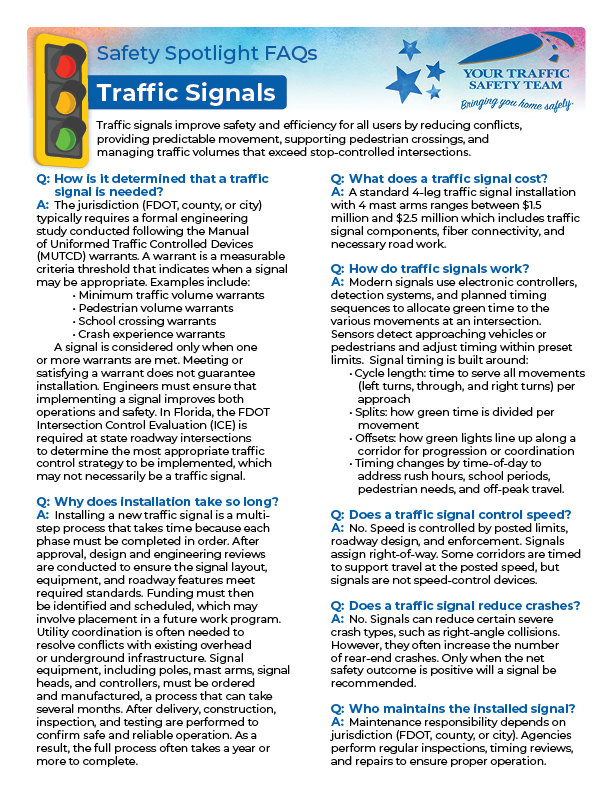
Safety Spotlight FAQs: Traffic Signals

How is it determined that a traffic signal is needed?

The jurisdiction (FDOT, county, or city) typically requires a formal engineering study conducted following the Manual of Uniformed Traffic Controlled Devices (MUTCD) warrants. A warrant is a measurable criteria threshold that indicates when a signal may be appropriate. Examples include:

  • Minimum traffic volume warrants
  • Pedestrian volume warrants
  • School crossing warrants
  • Crash experience warrants

A signal is considered only when one or more warrants are met. Meeting or satisfying a warrant does not guarantee installation.  Engineers must ensure that implementing a signal improves both operations and safety. In Florida, the FDOT Intersection Control Evaluation (ICE) is required at state roadway intersections to determine the most appropriate traffic control strategy to be implemented, which may not necessarily be a traffic signal.

Why does installation take so long?

Installing a new traffic signal is a multi-step process that takes time because each phase must be completed in order. After approval, design and engineering reviews are conducted to ensure the signal layout, equipment, and roadway features meet required standards. Funding must then be identified and scheduled, which may involve placement in a future work program. Utility coordination is often needed to resolve conflicts with existing overhead or underground infrastructure. Signal equipment, including poles, mast arms, signal heads, and controllers, must be ordered and manufactured, a process that can take several months. After delivery, construction, inspection, and testing are performed to confirm safe and reliable operation. As a result, the full process often takes a year or more to complete.

What does a traffic signal cost? 

A standard 4-leg traffic signal installation with 4 mast arms ranges between $1.5 million and $2.5 million, which includes traffic signal components, fiber connectivity, and necessary road work.

How do traffic signals work? 

Modern signals use electronic controllers, detection systems, and planned timing sequences to allocate green time to the various movements at an intersection. Sensors detect approaching vehicles or pedestrians and adjust timing within preset limits.  Signal timing is built around:

  • Cycle length: time to serve all movements (left turns, through, and right turns) per approach
  • Splits: how green time is divided per movement
  • Offsets: how green lights line up along a corridor for progression or coordination
  • Timing changes by time-of-day to address rush hours, school periods, pedestrian needs, and off-peak travel.

Does a traffic signal control speed? 

No. Speed is controlled by posted limits, roadway design, and enforcement. Signals assign right-of-way. Some corridors are timed to support travel at the posted speed, but signals are not speed-control devices.

Does a traffic signal reduce crashes?

No. Signals can reduce certain severe crash types, such as right-angle collisions. However, they often increase the number of rear-end crashes. Only when the net safety outcome is positive will a signal be recommended.

Who maintains the installed signal?

Maintenance responsibility depends on jurisdiction (FDOT, county, or city). Agencies perform regular inspections, timing reviews, and repairs to ensure proper operation.

Continue Reading