Safety Belt Use in Northeast Florida

Florida’s statewide safety belt use rate for 2025 is 90.8 percent, an improvement from the 2024 result of 90.0 percent. This annual statewide survey is primarily designed to provide a single safety belt usage estimate for the entire State of Florida, not official county rates. However, these rates are still helpful as they serve as reference points for changes over time.

Three counties are surveyed in our 18-county FDOT District Two. Out of the 31,545 statewide total of Observed Front-Seat Occupants, including drivers and passengers, there were 4,669 observed in Alachua (1,364), Duval (1,726), and St. Johns (1,579). This accounts for 14.8% of the total number observed out of the 15 counties surveyed throughout the state.

2025 Survey Results for Safety Belt Use in Northeast Florida

  • Alachua County 91.4% (up from 90.6% in 2024)
  • Duval County 87.7 (up from 86.5% in 2024)
  • St Johns County 87.9% (up slightly from 87.5% in 2024)

Notably, the usage rates are based on weighted data from two sets of sample sites: those used in 2017-2021 and those used in recent surveys. This could influence the shift in survey numbers, and decreases could be due to the different areas where new sites are located. For example, Alachua’s usage rate was 95%, and St. Johns was 92.1% in 2021.

Despite the year-to-year fluctuation, safety belt usage generally shows an upward trend. However, the recent decline indicates that occupant protection programs should seek to increase safety belt use among the groups with disproportionately low use identified in this survey.

Occupant Protection Messages in Response to Low Usage Rates

The low safety belt usage groups identified include pickup truck occupants, male passengers, occupants between the ages of 16-34, and black occupants.

Be Savvy, Buckle Up for ages 16-34
Occupants Ages 16-34: Be Savvy… Buckle Up
Buckle up in your truck
Occupants in Pickups: Buckle Up in Your Truck

Safety Belt Law History

In 1986, Florida implemented its first adult safety belt law. Safety belt use before the law was at 22% statewide. From 1999 to 2004, Florida’s use rate increased from 59% to just over 76% due to FDOT’s “Click It or Ticket” campaign and other efforts across the state. In 2009, Florida passed a primary enforcement safety belt bill, and safety belt use has increased since the law’s passage. Working together, we can continue to increase safety belt use and reduce fatalities and injuries on our roadways.

“Always Buckle Up … for Your Family. For Yourself. For LIFE.” 
No Regrets When You BUCKLE UP!

Move Over or Slow Down

Every January is Move Over Month in Florida. The Northeast Florida Department of Transportation District Two Community Traffic Safety Program reminds all motorists to obey Florida’s Move Over Law. This law helps to protect those who protect us while they provide essential services in a dangerous environment – the side of the road.

Florida law requires motorists to move over a lane — when they can safely do so — or slow down by 20 mph below the posted speed limit for the following stopped along the roadway:

  • Law enforcement.
  • Emergency responders.
  • Sanitation and utility service vehicles.
  • Tow trucks or wreckers.
  • Maintenance or construction vehicles.
  • Disabled vehicles.
Move Over or Slow Down
Move Over
Slow Down if unable to move over
Slow down if unable to move over
Pull over for emergency and law enforcement vehicles
Pull over for moving emergency and law enforcement vehicles

Florida’s Move Over Law expanded in 2021 to include service vehicles and again in 2024 to include disabled motorists

In addition to first responders, this law, as of 2021, also applies to other public servants and roadside workers. Drivers typically know to move over for law enforcement, fire rescue, and emergency medical services. Many still do not realize the law requires them to move over for sanitation, utility, wrecker, maintenance, and construction vehicles. Basically, if motorists see a service vehicle on the side of the road with flashing warning lights, they need to change lanes or slow down.

Florida lawmakers took action to enhance protection for all roadway users. Effective January 1, 2024, the expanded Move Over law adds three scenarios to Florida’s current law. Motorists will be required to move over if:

  • There is a disabled motor vehicle that is stopped and displaying warning lights or hazard lights.
  • If a vehicle is stopped and is using emergency flares or posting emergency signage.
  • When a vehicle is stopped and one or more persons are visibly present.
Florida Law, Move Over and Slow Down for Stopped Emergency and Service Vehicles

In 2022, there were 170 crashes and more than 14,000 citations issued for motorists failing to move over in Florida, according to the Florida Department of Highway Safety and Motor Vehicles (FLHSMV). Obeying Florida’s Move Over law will help ensure all personnel working and motorists disabled along our roadways get home safely.

Move Over

  • As soon as it is safe to do so, vacate the lane closest to the stopped law enforcement, emergency, sanitation, utility service vehicles, tow trucks or wreckers, maintenance or construction vehicles with displaying warning lights, and any disabled vehicle on the side of the road when driving on an interstate highway or other highways with two or more lanes.
  • Always signal your intention to change lanes.
  • Be prepared to allow those who are attempting to move over into the next lane.

Slow Down

  • If moving over cannot be safely accomplished, or when on a two-lane road, slow down to a speed that is 20 mph less than the posted speed limit when the posted speed limit is 25 mph or greater, or travel at 5 mph when the posted speed limit is 20 mph or less when driving on a two-lane road.

Violating the Move Over law puts you and others at risk, and a citation will result in a fine, fees, and points on your driving record. To read the Florida Statue, see 316.126 – Operation of vehicles and actions of pedestrians on approach of an authorized emergency, sanitation, or utility service vehicle.

Pull Over for Moving Emergency Vehicles

Additionally, motorists should always remember to pay attention while driving and pull over for emergency vehicles approaching from behind. Help emergency services reach their destination safely by:

  • Yielding the right of way.
  • Moving to the closest, safe edge of the roadway.
  • Clearing the intersection.
  • Remaining stopped until the emergency vehicle has passed.
  • Proceeding with caution and courtesy when merging back into the roadway.

Buckle Up and Slow Down

Hey Guys, Slow Down! There is an over-representation of fatality and injury crashes with young men, ages 18–24, in Northeast Florida rural counties, caused by speeding and lower safety belt usage. We aim to reduce traffic fatalities and serious injuries by increasing safety belt usage and reducing excessive speeding. We’re taking a thoughtful approach to traffic safety—and we hope you’ll join us on this journey to save lives.

Drive like your future depends on it… because it does.

Improving roadway behaviors starts with us! Positive change begins by buckling up when you get in your vehicle, slowing down, and focusing on the road. Let’s keep the good vibes rolling—so we don’t come to a dead end. Life is a journey. Drive safely to reach your destination and your destiny.

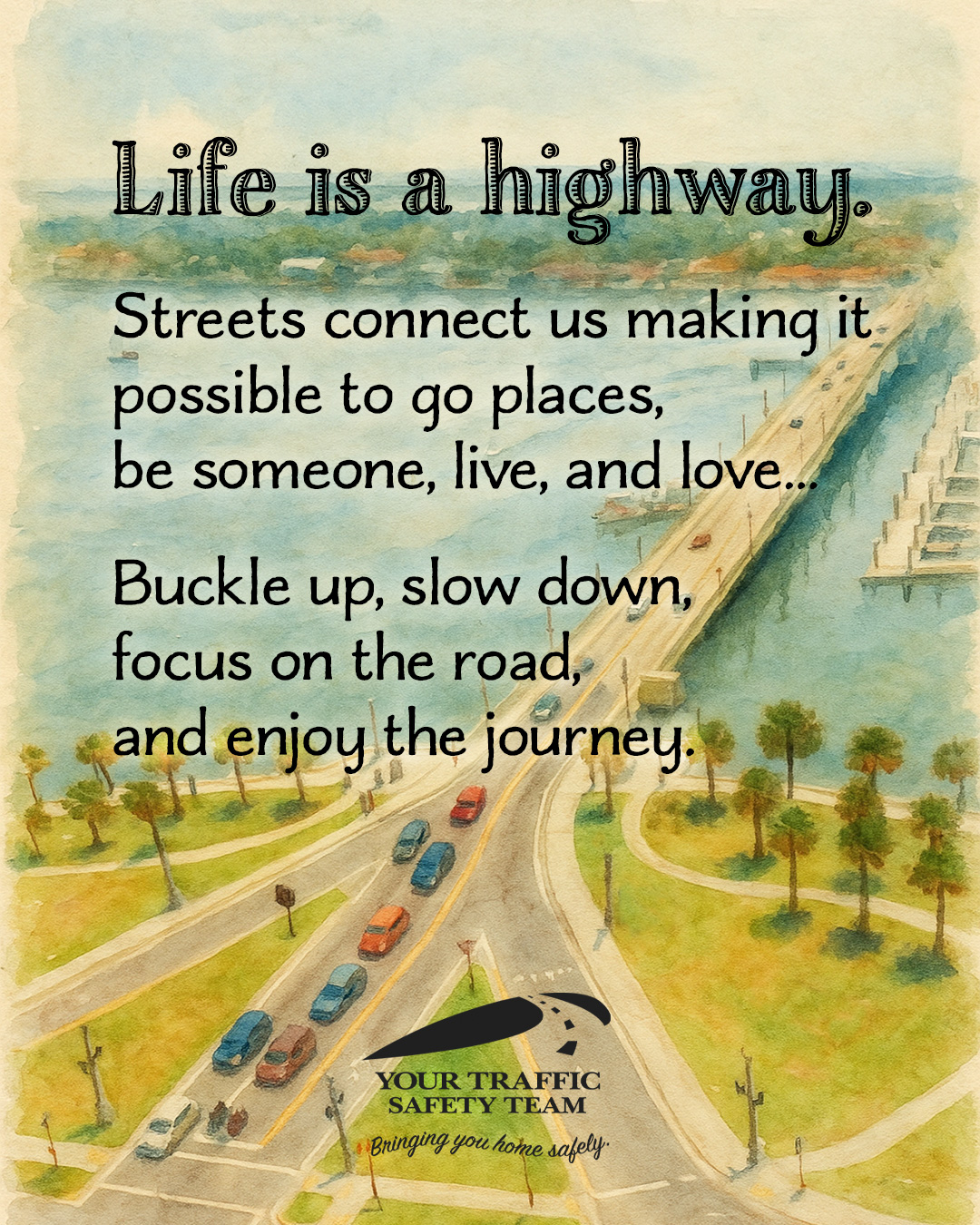
Life is a Highway

Share these graphics to help spread the message. #LifeIsAHighway #DriveSafe

Life is a Highway - Buckle Up and Slow Down

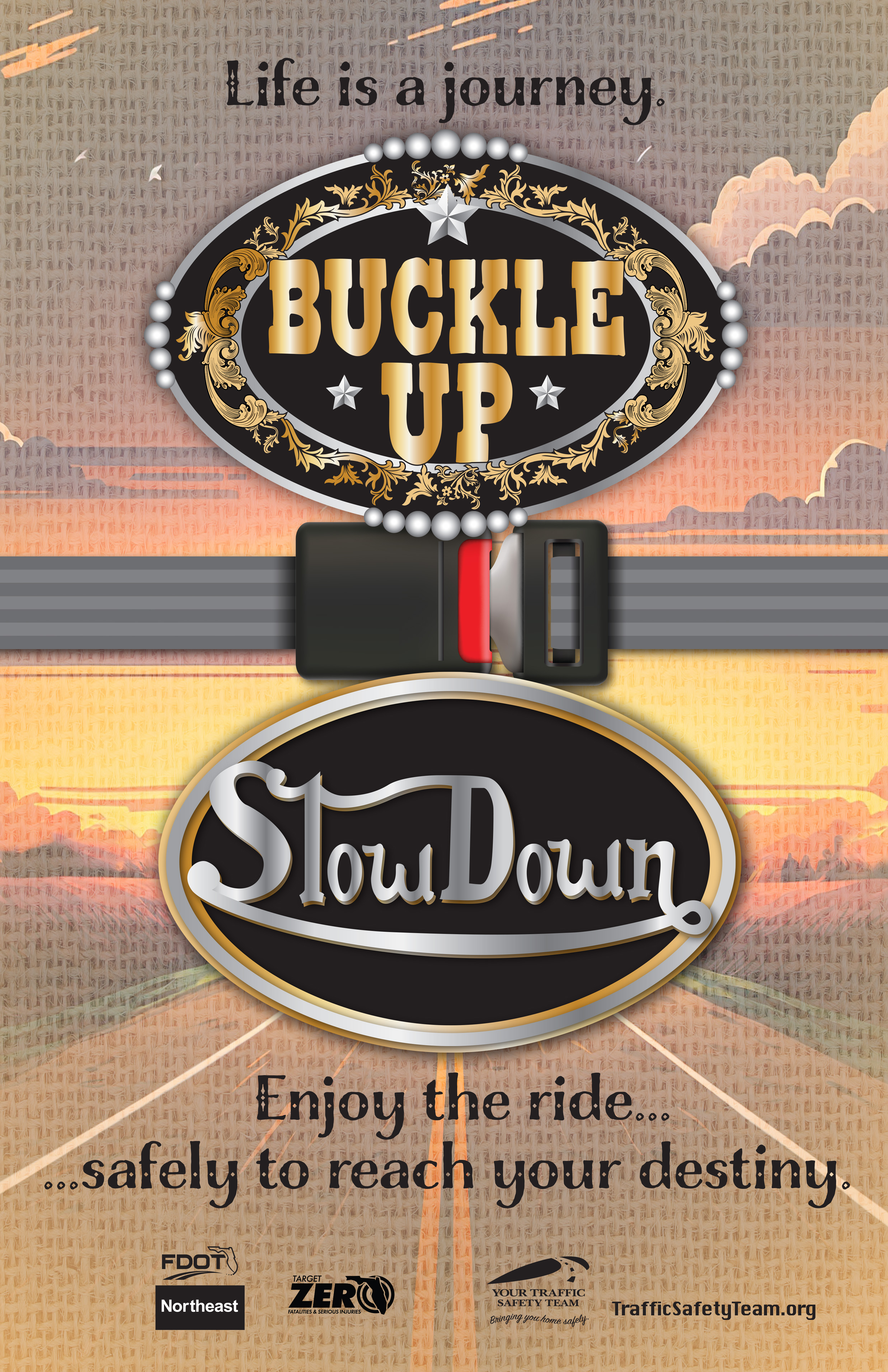
Buckle Up and Slow Down Poster and Banner

To help change this behavior, we created custom safety messages. The core idea is to save your life and protect your future. We need community outreach and connection to encourage slowing down and making driving safe the norm. Our new materials feature country-styled belt buckles with the messages “Buckle-Up” and “Slow Down,” conveying the idea that Life is a journey. Enjoy the ride… safely to reach your destiny. We want drivers to feel it’s okay NOT to be the fastest on the road. 

Rural Buckle Up and Slow Down poster and banner
Click here to download a printable version of our Buckle Up and Slow Down poster.

Buckle Up and Slow Down

Help make buckling up the social norm and driving at safe speeds part of our safety culture. Please download and share our Buckle Up and Slow Down printable POSTER and square social media GRAPHIC. You may print this flyer as a handout tip card, include it in an email or newsletter, or post it on social media. Don’t forget to tag us on Facebook and Instagram @trafficsafetyteam and on Twitter and LinkedIn @trafficsafetyfl and hashtag #SlowDownFL #BuckleUpFL #TrafficSafetyFL

speeding, aggressive drivers, occupant protection, Country Buckle Up Belt and Slow Down Belt Buckle

We want all motorists, especially young male drivers between the ages of 18 and 24, to change their mindset about speeding and realize it’s not worth the risk to their life or future. After interviewing this target audience in Northeast Florida, we gained a deeper understanding of some barriers and behavioral determinants of excessive speeding. We found that they frequently exceeded posted speed limits by a significant margin on rural roadways.


Slow Down – District Two Market Research

Levy and Suwannee are two counties in Northeast Florida with a population under 44,000. Comparing these counties with other similarly sized counties in Florida, they are ranked most problematic (#1 and #3) in the issues of both speed and teen drivers per the FY2024 Highway Safety Matrix.

Examples of why speeding among young male drivers on rural roads is a problem include:
  • Limited law enforcement presence
  • Roadway characteristics – curvature, grade, width, and adjacent land use
  • Delayed EMS response times
  • Pickup trucks are more likely to roll over, especially when significantly altered/lifted; they are top-heavy
Formative data:
  • NHTSA 2020 Speeding Traffic Safety Facts – Thirty-five percent of male drivers in the 15- to 20-year-old age group involved in fatal crashes in 2020 were speeding, the highest among the age groups.
  • GHSA Teens and Speeding – from 2015 to 2019, teen drivers and passengers (16 – 19 years of age) had a greater proportion of speeding-related fatalities (43%) than all other age groups. Men were almost twice as likely as women to say that they drove at extreme speeds much more often than normal. 
  • Speeding-related teen driver fatal crashes – the driver is more likely to be male (37% vs. 28%), have run off the road or rolled over the vehicle, and to be unbelted.
  • Male drivers in every age group account for the greatest proportion of fatal crashes involving speeding.
  • NTSB – The relationship between speed and injury severity is consistent and direct. 
  • NHTSA – Drivers classified as speeders were almost three times as likely as sometime speeders to strongly agree with the statements, “I often get impatient with slower drivers” (45% versus 18%), “I enjoy the feeling of driving fast” (19% versus 6%), and “I try to get where I am going as fast as I can” (11% versus 3%).
Insight – Younger male drivers enjoy excessive speeding in rural areas without regard to safety or the law. Barriers and behavioral determinants:
  • Entitlement (the belief that their need to reach a destination is more important/deserving, ‘own the road.’)
  • Personable responsibility and self-protection
  • Driving over the speed limit is not dangerous for skilled drivers (male dominant attitude)
  • Hustle mentality
  • Traveling with the flow of traffic (everyone speeds)
  • Enjoy driving faster (extreme risks feel exciting, adrenaline rush)
  • Not predetermined, in-the-moment decisions to speed

Other materials, information, and resources available on our website about occupant protection, speeding, and driving tips for teens:

Bicycle Lanes

Bicycle Lanes: Why We Don’t Always Have Them—and Why They Matter

If you’ve ever looked at a busy street in your neighborhood and wondered, “Why don’t we have bicycle lanes here?” You’re not alone. Whether you’re a daily rider, a parent, a planner, or simply someone who wants safer streets, bike lanes are a frequent topic of discussion.

Why Don’t We Just Build More—and Better—Bike Lanes?

Even when there’s strong support for adding bike lanes, they can’t always be installed everywhere. There are a few good reasons why. In some places, there simply isn’t enough space to add a bike lane without removing on-street parking or vehicle travel lanes, which can create other community concerns. Design standards also play a big role.

Florida’s Design Manual sets strict requirements for things like lane width, visibility, and roadside clearance. If a road doesn’t meet those standards, a bike lane might not be allowed. Then there are legal restrictions: for example, highways and limited-access roadways are off-limits to bicycles under Florida law.

And of course, funding is always a factor. Transportation budgets are limited, so bike lane projects are usually prioritized where there’s a clear safety issue or high demand. Even once bike lanes are in place, they’re not a one-and-done deal. They require ongoing maintenance, including sweeping, repainting faded markings, and keeping the lanes clear of obstructions.

What Is a Bike Lane?

Not all bicycle accommodations are the same. While the term ‘bike lane’ is commonly used, it actually refers to only one type of bicycle facility. According to the Florida Department of Transportation Design Manual (FDM), a bicycle facility is any feature designed to support and accommodate bicycle travel. This includes a range of infrastructure treatments, such as bike lanes, keyhole lanes, paved shoulders, separated bicycle lanes, shared-use paths, bicycle ramps, and specialized intersection treatments like bicycle boxes and two-stage turn boxes. Each serves a different purpose depending on traffic, roadway conditions, and user needs—which is why it’s important to understand how bike lanes fit within the broader bicycle network.

Types of Bicycle Facilities

Bicycle Network and Lane Types
(Source: FHWA)

A bike lane is a part of the road marked off just for people riding bicycles. You’ll usually see white lines, bike symbols, and sometimes green paint or buffer zones. These lanes help create a safe and predictable space for riders—so they’re not squeezed between moving cars or forced onto sidewalks.  Florida follows specific standards outlined in the FDM and the Manual on Uniform Traffic Control Devices (MUTCD) when designing bike lanes.

Bike Lane vs. Paved Shoulder

While they might look similar at first glance, there’s an important difference between a designated bike lane and a paved shoulder.  A bike lane is a specifically marked and signed part of the roadway reserved for bicycle use. It includes pavement markings like the bike symbol and directional arrows, and often signage letting drivers know it’s there. In contrast, a paved shoulder is primarily meant for emergency stopping or vehicle recovery, but it can sometimes serve as a bicycle facility if it meets certain width and safety requirements. However, if it’s not marked as a bike lane, it doesn’t offer the same level of recognition or legal protection for cyclists.

Why Bike Lanes Matter

Bike lanes provide more than convenience. They’re about safety, access, and choices. They make it easier and safer for bicyclists to get to school, work, the store, or a park. This is especially on busy streets.  And they serve a wide range of people: students biking to class, parents riding with their kids, older adults getting exercise, people who don’t own a car, tourists exploring town, and workers commuting or making deliveries. 

Bike lanes also reduce vehicle congestion, cut down emissions, and make neighborhoods more walkable and livable. That’s why agencies like the FHWA and FDOT support better bike infrastructure as part of Complete Streets policies.

Advocacy groups, such as Bike Florida, North Florida Bicycle Club, and local cycling coalitions, as well as residents, champion for safer bike infrastructure. They help shed light on bike safety issues. Their efforts often lead to positive change.  Even when local agencies agree on the need, they often face tough limitations. Some include right-of-way issues, funding constraints, outdated road designs, or legal barriers. Understanding the why can help communities work together on how to make things better.

Understanding Bicycle Lane Features and Design Treatments

Bike lanes come in many forms. What works on a quiet residential street may not work on a six-lane urban arterial.  More communities are pushing for protected lanes, especially in high-traffic areas, based on new guidance from the FHWA Bikeway Selection Guide and modern safety research.  Designing bicycle lanes involves more than painting a white line on the roadway. Effective bicycle facilities are built with safety, visibility, and predictability in mind. The FDM outlines a range of features to consider when implementing bicycle lanes. Each is tailored to reduce conflicts and improve user experience for all road users, not just cyclists. 

Here’s a breakdown of some key components:

Bicycle Lane Features and Design

Pavement Markings

Bike lanes are marked using a helmeted bicyclist symbol and directional arrow at the start of the lane, after major intersections, and within keyholes. Green-colored pavement helps highlight potential conflict areas, especially where bikes cross vehicle paths or near bus bays.

Signage

Signage such as ‘Bike Lane Ahead’ and ‘Bike Lane Ends’ enhance awareness and regulatory clarity.

Keyhole Lanes

Keyhole lanes guide bicyclists through areas with right-turn lanes or parking bays. Typically buffered and at least 5 feet wide, these lanes allow for continuous through movement. Pavement markings and width adjust based on geometry and available space.

How to Ride Them

Using a bicycle lane is relatively straightforward, but there are a few essential considerations to keep in mind for staying safe and predictable on the road. First, always ride in the same direction as traffic. Bicycle lanes are one-way facilities that flow alongside vehicles, not against them. Ride toward the center of the bike lane to avoid road debris and the opening doors of parked cars.

As you approach intersections or driveways, be extra alert for turning vehicles that may cross into your path. If the bike lane shifts into a keyhole configuration near a right-turn lane, continue riding straight and predictably through the designated space. It’s also important to use hand signals when turning or changing lanes so drivers and other riders know what you’re doing.

Obey all traffic signals and signs, just like you would if you were driving. And don’t forget—if you’re crossing a crosswalk or shared space, yield to pedestrians. Staying aware and predictable helps everyone share the road more safely.

Sources:
Manual of Uniform Traffic Control Devices (MUTCD)
Florida Design Manual
FHWA Bikeway Selection Guide

School Traffic Camera Enforcement

Effective July 1, 2023, Florida law allows camera enforcement of school zone speed limits and illegal passing of school buses. School traffic camera enforcement and safety has especially been a topic of discussion for our Northeast Florida communities and team members.

Planning for School Traffic Camera Enforcement in Florida

FDOT District Two Traffic Operations Engineer Jim Hannigan explained the proposed guidelines. He answered questions during a recent Districtwide Team meeting. 

Pursuant to Section 316.0776, Florida Statutes (F.S.), the FDOT may approve the placement or installation of a Speed Detection System (SDS) in a School Zone on the State Highway System (SHS), as defined in Section 334.03(24), F.S. SDS installations on the SHS must be authorized through a General Use Permit in accordance with Rule 14-20.010 of the Florida Administrative Code. This is similar to the process used for Automated License Plate Recognition (LPR) Systems and Traffic Infraction Detectors (Red Light Running Cameras).  

If your community is interested, please visit the FDOT School Zone Speed Detection System webpage to read an overview of the process and criteria, which include:

  • Placement and Installation Specifications
  • Special Provisions for General Use Permit
  • Frequently Asked Questions
  • Contact Information

Florida Enforcement of School ZONE Speed Limits Law

School ZONE Speed Detection Cameras – District Two News and Information:

School ZONE Speeding in the News in other areas throughout Florida:

Florida Enforcement of School BUS Passing Violations Law

School BUS Camera Programs – Florida News and Information:

We are following the usage of school zone speed detection and school bus cameras to improve safety and deter illegal speeding and passing. If you are aware of any other local municipalities in Northeast Florida that plan to install and maintain cameras for enforcement purposes, please let us know.

Additionally, see our School Bus Safety resources for drivers and student passengers: