

Safety for Electric Bicycles, Scooters, and Unicycles
Electric bikes and e-scooters continue to grow in popularity across Northeast Florida, especially among younger riders traveling through neighborhoods and to and from school. As use increases, education and safety awareness remain a priority concern for our communities.

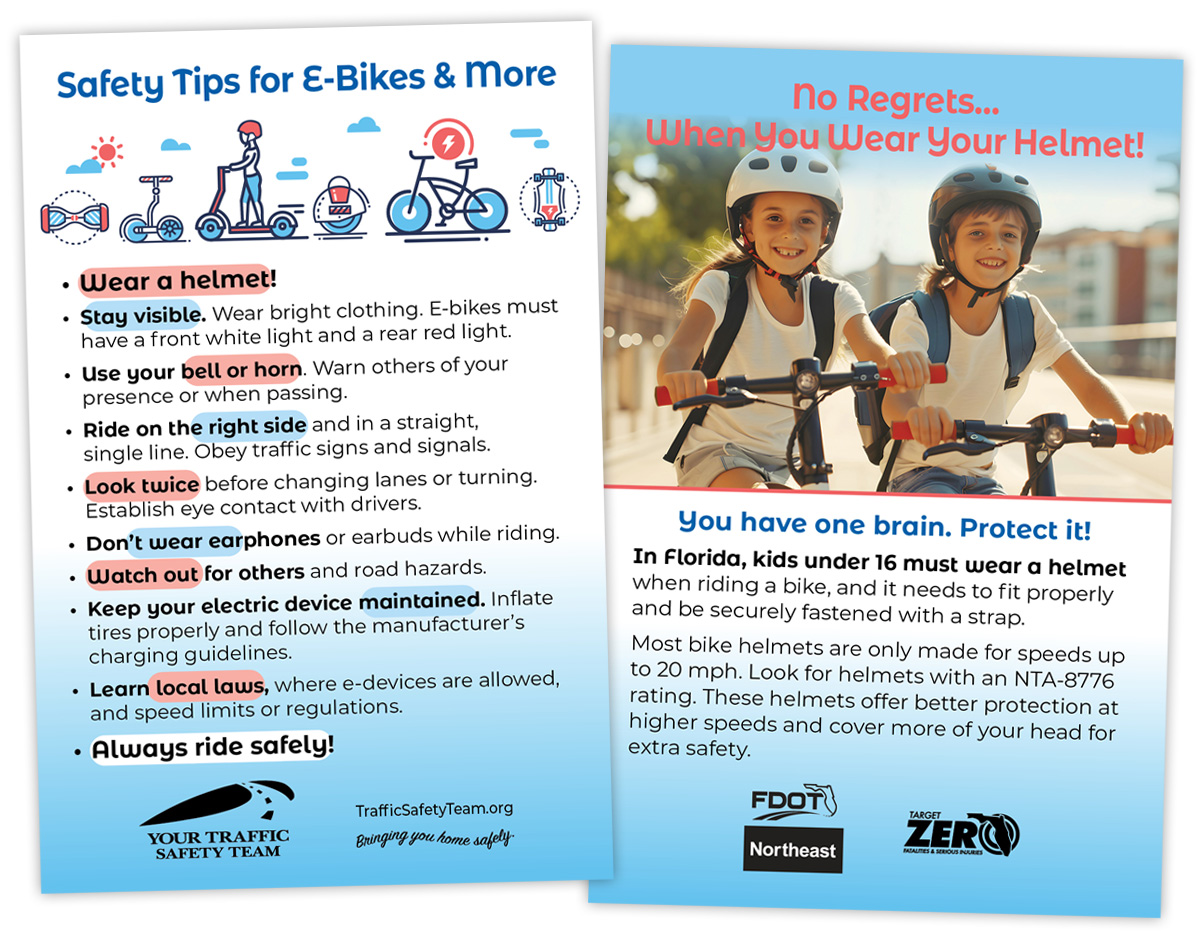
Below are free resources to download, print, and share. To support the outreach and education efforts of our Northeast Florida District Two Traffic Safety Team, agencies, schools, and partners, we offer our NEW folded “E-Bike + E-Scooter Safety Tips” bi-fold flyers at no cost. District Two CTST members may click here to order online, while supplies last.
Help encourage safer riding habits and smarter choices, including:
• Helmet use and visibility
• Riding responsibly and obeying traffic laws
• Slowing down around pedestrians
• Hand signals and safe passing
• Staying alert and distraction-free
• Courtesy and shared responsibility on roads, sidewalks, and shared paths
The handout encourages riders to “Ride Smart” by focusing on safe behaviors that help prevent crashes and injuries. The materials are ideal for school programs, community events, youth outreach, law enforcement education efforts, neighborhood initiatives, and safety campaigns.
E-Bike Safety Materials
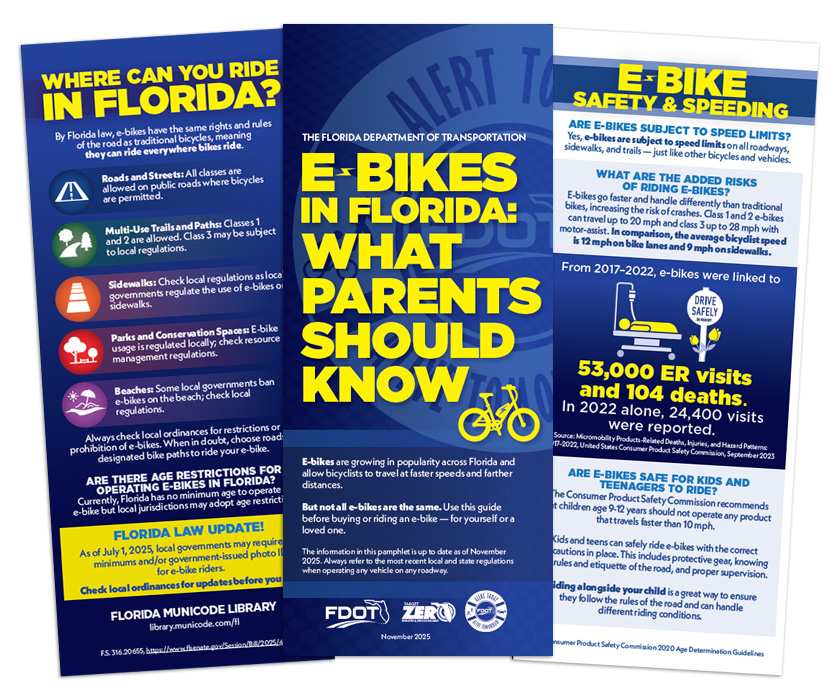
We have gathered e-bike safety recommendations, tips, and guidelines. Please use and share these materials, videos, and information to help improve safety and encourage safe use of e-bikes and other micromobility devices.




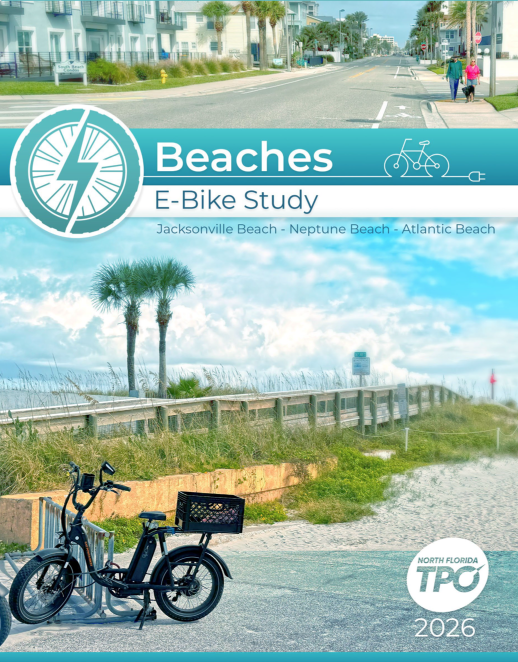
Beaches E-Bike Study
In July 2026, the North Florida Transportation Planning Organization (TPO) released this E-Bike Study for Jacksonville Beach, Neptune Beach, and Atlantic Beach. This study was undertaken in response to the local need for greater clarity, consistency, and safety regarding micromobility operations. It evaluates how E-Bikes and other forms of micromobility are currently being used throughout the Beaches municipalities, what safety issues are emerging, how existing federal, state, and local policies frame micromobility operations, and what strategies may be available to improve outcomes for riders and non-riders alike.
This study is organized into five sections:
- Current Trends in E-Bike Usage
- Existing Laws and Policies
- Safety Analysis
- Public Outreach
- Recommendations
Since 2023, we have held Districtwide Discussions regarding electric micromobility devices and safety. In 2025, we hosted another e-bike safety discussion with members of our District Two Traffic Safety Team to address ongoing concerns and rising injuries. As the use of e-bikes and e-scooters continues to grow, your participation in these conversations helps shape a more informed and proactive approach to addressing emerging challenges on our roads.
With expert insights and local perspectives, member engagement made this a valuable and productive meeting. A special thank-you to our presenters: Mark Sekelsky and Brian Benwick of the North Florida Bicycle Club; Rebecca Melvin, Trauma Injury Prevention, Education and Outreach Coordinator at UF Health Jacksonville; and Jackie Morrison, Community Health Educator and Safe Kids Northeast Florida Coordinator at Wolfson Children’s Hospital.
Here are links to the presentation, which includes our presenter’s slides, along with additional resources:
- E-Bike Safety Meeting 08-06-25: Click here for the presentation slides [PDF]
- Florida Pedestrian and Bicycle Safety Coalition’s Professionals Webpage with Micromobility Model Legislation
- Florida Bicycle Safety Quiz: https://flbikesafetyquiz.com/
- E-Bike Riding Skills and Safety Training Course: https://ebikecourse.com
- Kids Modifying Ebikes: Why These Dangerous Bike Hacks Put Teens at Risk, by American Bicycling Education Association (ABEA)
- ABEA’s Cycling Savvy e-bike course for Teens
We have been addressing e-bike concerns since the early 2020s. In 2022, we created a presentation on micromobility, discussing terms, usage, and safety challenges nationally and in Northeast Florida. In 2023, we held multiple district-wide meetings addressing roadway concerns and issues regarding micromobility—specifically electric bicycles, scooters, unicycles, and golf carts or low-speed vehicles. Undoubtedly, tackling these safety concerns, from educating the public to tracking e-bike/scooter/unicycle crashes, trauma injuries, and enforcing local ordinances, will take a group effort.
Senate Bill 462 – Transportation was approved by Governor Ron DeSantis. The bill [Chapter No. 2025-149] went into effect on July 1, 2025, and will give local governments the authority to adopt additional regulations related to electric bicycles.
Key provisions of SB 462 include allowing local governments to:
- Adopt ordinances establishing minimum age requirements for operating an electric bicycle.
- Require operators of electric bicycles to possess government-issued IDs while riding.
- Provide training on the safe operation of e-bikes and compliance with relevant traffic laws.
Legislation filed in November 2025 was VETOED by Governor Ron DeSantis: CS/SB 382: Micromobility Device
- Senate Bill 382 [passed by Florida Senate and House, vetoed by Governor] – Micromobility Device; Providing requirements for the operation of electric bicycles; prohibiting the operation of an electric bicycle above a certain speed under certain circumstances; creating the Micromobility Device Safety Task Force adjunct to the Department of Highway Safety and Motor Vehicles; requiring the Florida Highway Patrol and each police department and sheriff’s office to maintain a certain list, beginning on a certain date, etc.
Please take a moment to review the resources, local ordinances, Florida law, and news article links below related to e-bike safety. Check out input from CTST member Brian Benwick of the North Florida Bicycle Club. Also, please read “An Approach to E-Bike Safety” by CTST member Antonia Donnelly.
2026 Florida E-Bike Safety Ordinances, Guidelines, and News
- 09-15-26 Jacksonville City Council committee advances e-bike safety ordinance limiting sidewalk speeds News 4 Jax
- 08-18-26 Jacksonville proposed e-bike ordinance may change after stakeholder meeting; age limit could be removed News 4 Jax
- 08-14-26 Kids keep getting hurt and killed on e-bikes. Should parents be held responsible? News 4 Jax
- 08-13-26 Teen e-bike rider injured in Clay County hit-and-run near Clay High First Coast News
- 07-31-26 Nassau County School District requiring middle, high school students to obtain permit to ride e-bikes to school First Coast News
- 07-31-26 Jacksonville to consider tighter e-bike rules as injuries rise and back-to-school nears News4Jax
- 07-06-26 News4Jax: Fernandina Beach unanimously passes new rules for e-bike riders amid safety crackdown
- 06-26-26 Jax Today: DeSantis vetoes e-bike regulations, warning about government surveillance
- 06-25-26 St. Augustine Record: Gov. DeSantis vetoes Florida electric bike bill. As sales of e-bikes have skyrocketed, so have complaints and crashes.
- 06-19-26 News4Jax: Death of 14-year-old in e-bike crash sparks safety concerns on Clay County road
- 05-20-26 Fernandina Observer: Fernandina Beach approves e-bike crackdown after warning
- E-bikes speed limits likely to become Florida law. What will change
- Florida e-bike bill waits for governor’s signature after unanimous approval from lawmakers
- Florida Senate OKs new speed limit for E-Bikes
- Legislation to create e-bike safety task force passes the Florida Senate
- Florida Senate unanimously passes e-bike crackdown, caps speeds near pedestrians
- Florida Law Enforcement Liaison’s E-Bike Resources, Statutes, and Local Ordinances
- 03-06-26 ‘It starts in the home’: St. Johns County Sheriff continues to ramp up e-bike enforcement First Coast News
- 02-05-26 Senate panel backs electric bike task force bill, but wants e-scooters included, Florida Politics
- 01-20-26 Senate panel advances bill establishing task force to propose e-bike regulations, Florida Politics
2025 Florida E-Bike Safety Ordinances, Guidelines, and News
- 10-30-25 Lawmakers rev up safety rules for e-bikes with new bill, Florida Politics
- E-bike injuries doubled in a year — and they’re still rising, Jax Today 9-4-25
- St. Johns County commissioners unanimously adopted a new e-bike safety resolution, Action News Jax, 8-6-25
- Surge in e-bike crashes prompts St. Johns County Sheriff’s Office safety crackdown, News4Jax, 07-16-25
- St. Johns County Sheriff’s Office increasing enforcement, education for e-bike riders after increase in accidents, News4Jax, 07-01-25
- St. Johns County launches E-bike safety push after rising concerns, First Coast News, 06-30-25
- New state regulations aimed at enhancing e-bike safety await governor’s signature, News4Jax 06-11-25
- St. Johns County puts the brakes on stricter e-bike rules, Jax Today 06-03-25
- With e-bike crashes on the rise, St. Johns County commissioners consider hot-button safety ordinance proposal – Among other changes, anyone under 18 would have to wear a helmet on an e-bike or e-scooter, News4Jax 06-03-25
- St. Johns County commissioners to revisit e-bike safety ordinance proposal, News4Jax 06-01-25
- Back-to-back e-bike crashes involving children prompt safety crackdown in St. Johns County, Action News Jax, 05-05-25
- St. Johns County – Child’s e-bike crash in St. Johns County raises safety questions, Action News Jax, 04-29-25
- Atlantic Beach City Commission approved an ordinance aimed at regulating bikes, e-bikes and personal mobility devices, 03-28-25
- 04-07-2025 E-bikes could make a comeback to Neptune Beach, Action News Jax
- 02-25-2025 Atlantic Beach City Commission to introduce legislation targeting e-bike safety News 4 Jax
E-Bike Safety News in Northeast Florida 2020-2024
- 04-21-2024 Neptune Beach Police Department posted signs to stop ‘dangerous operations of e-bikes’ News4Jax
- UF – Mircromobility (E-Scooters) Pilot Program, Personal Protective Equipment Policy for Employees, and Policy Prohibiting Bicycles and other Transportation Vehicles in University Buildings
- Nassau County – updated rules June 2021 on E-Bikes to comply with recent state legislative action
- City of Neptune Beach – Ordinance 2021-14 regarding micromobility and motorized scooters
- City of Jacksonville – Sec 235 Dockless Mobility Program definitions and requirement
- St. Augustine Beach – Chapter 19 – Traffic, Article IV. Public Sidewalks and Walkways with definitions, rights-of-way, and operation of a shared mobility device program
- City of St. Augustine – 2019 definitions, right of ways, regulations: ORDINANCE NO. 2019-02
- St. Johns County – 2023 Draft, relating to pedestrian and vehicle safety within public roads and rights-of-way
- City of Gainesville – Article VII, Sec. 26-190-201 and Ordinance 2022-577 related to Micromobility Services
- St. Augustine Launches E-Bikeshare Program | August 2021 | WJCT News
Reference Materials for the E-Bike/Scooter/Unicycle Safety Discussion –
- 01-16-2025 University of Miami KiDZ Neuroscience Center’s Position Statement on Electric Scooters (“E-scooters”)
- GHSA’s 2023 Research Project E-Scooter Safety Toolbox
- FHWA’s 2023 E-Bike Fact Sheet Environment: Defining, Regulating, Topic Areas, Research Needs, and Case Studies
- FHWA’s Fact Sheet Micromobility: Emergence of New Transportation Modes
- FHWA’s Public Roads Micromobility: A Travel Mode Innovation
- FHWA’s Environment, Bicycle and Pedestrian Program Resources on Electric Bikes
- Summary of Florida Legislation statutes regarding electric bicycles
- Comparing injuries from e-scooters, e-bikes, and bicycles in the United States, Volume 4, June 2025, 100061, Science Direct, Journal of Cycling and Micromobility Research
- NTSB’s Safety Research Report SRR-22-01 Micromobility: Data Challenges Associated with
Assessing the Prevalence and Risk of Electric Scooter and Electric Bicycle Fatalities and Injuries - E-Scooter and E-Bike Injuries Soar: 2022 Injuries Increased Nearly 21% US CPSC
- Learn about the world of electric bikes by People for Bikes Advocacy
- BMJ Journals’ Injuries associated with electric-powered bikes and scooters
- Federal Lands Planning Program – The Future of E-Bikes on Public Lands Research Study
- ScienceDirect Journal of Safety Research, February 2023 – Comparison of motor-vehicle involved e-scooter fatalities with other traffic fatalities
- UF Health, February 20, 2023 – Child Safety on Micromobility Devices
E-Bikes in the News and in Other Communities in 2025
- Rate of injuries from e-scooter accidents up, Other micromobility vehicles also a concern, USA TODAY, 08-07-25
- Edgewater moves to ban e-bikes and scooters from sidewalks, public parks, Click Orlando
- Palm Coast – Flagler County high-speed e-bike chase prompts sheriff to propose new ordinance, Central Florida News 13, 07-18-25
- New law allows Key to set age limits for e-bikes, e-scooters, Islander News 05-25-25
- Electric bikes speed toward regulations in Manatee County, Sarasota Observer 05-08-25
- Jupiter hosts first-ever e-bike safety festival to promote community awareness, WPTV 05-17-25
- Boynton Beach police say they get calls for bike-related incidents ‘at least every other day’, WPTV 04-22-25
- Horizon West resident calls for e-bike training for students, Central Florida 04-14-25
- ‘IT SCARES ME’: E-bike safety concerns grow in Boca Raton, WPTV 04-07-25
- E-bike and scooters in the spotlight after crashes, Fox 35 Orlando 03-25-25
- Jupiter officials host town hall to address e-bike concerns, solutions, WPBF 03-21-25
- 02-12-2025 Sanibel’s new rangers educate cyclists on path rules and e-bike limits, WINK
Related News from 2023-2024
- 06-12-2024 Key Biscayne permanently bans motorized scooters and e-bikes, Miami-Dade
- 04-21-2024 Neptune Beach Police Department posted signs to stop ‘dangerous operation’
- 04-05-2024 Jupiter boy hospitalized after crash while riding electric bike, West Palm Beach
- 03-27-2024 Deadly scooter accidents highlight a new technology at odds with South Florida lifestyle
- WUSF Public Media Article: E-bikes are everywhere, but not everyone is happy about that
- Pinellas Beaches Patch: Use Of Electric Bikes, Scooter Addressed In New Treasure Island Rules
- South Tampa-Hyde Park Patch: Voucher Program to Provide eBikes to Tampa Residents
- New York City DOT: Electric Bicycles & More
- Bicycle Retailer and Industry News: E-Bike Regulation Discussion an ‘Eye-Opener’ for Industry
- 850 WFTL News: U.S. lawmakers reintroduce e-bike tax credit bill
- San Diego County Bike Coalition: California E-Bike Policy Explained + Safety Basics
- Los Angeles County: E-Scooter and Bicycle Safety Tips
Fire Concerns with Electric Devices – Overcharging and aftermarket batteries seem to be a trigger. Additionally, fire extinguishers do not work on these lithium battery explosions or fires which spread rapidly.
- Lithium battery on e-bike causes house fire in Boca Raton 09/10/24 WTVX
- Lithium batteries in golf cart spark fire that destroys E-Town home, firefighters say (news4jax.com)
- Lithium-ion battery fires are happening more often. Here’s how to prevent them | CNN Business
- Lithium Battery Recycling Regulatory Status and FAQs | US Environmental Protection Agency
Amid growing popularity of electric devices, some university campuses are banning e-bikes and e-scooters due to safety concerns – primarily fire hazards and collisions with pedestrians.
E-Bike Insurance by Brian Benwick –
First, one of the main issues involving e-bike use and ownership should be mentioned… LITTLE OR NO INSURANCE. Click here for the Bicycle Floaters Chart. The liabilities arising from at-fault bicycle accidents can be covered automatically under one’s homeowner policy. However, they are not automatically covered if riding an e-bike. Neither the bike shops, parents, nor the kids who ride e-bikes are familiar with this issue. Generally, this makes e-micromobility somewhat of a public nuisance.
Updated 11/29/23: Markel’s specialty program, described in the chart, now has up to $300,000 maximum liability limit. This is good news because now, with the $300,000 limit chosen, your personal umbrella liability policy may recognize the underlying coverage and “dovetail” the e-bike cyclists’ coverage into your excess liability limits, albeit for an extra charge. You will probably need to submit a change application for approval first so that usage, driver information, e-bike policy number, limits and effective dates, along with a description of your e-bike with the serial number can all be reviewed by the personal umbrella underwriter.
Additional Points by Brian Benwick –
Secondly, we must consider the other types of micromobility before we can single out e-bikes for usage restrictions. Among bikes alone are road, mountain, gravel, cargo, commuter, unicycle, recumbent, elliptical, trikes, and more. And each of these categories more than likely has an e-bike version. Hoverboards, skateboards, golf carts, scooters, segways, roller skates, wheelchairs, and others would also need to be considered.
Helmet requirements are another concern, as head injuries are devastating. Though not required by law, our club (NFBC) requires them for all participating riders, young or old. But I understand the hygiene issues involved in sharing helmets; we all don’t carry helmets with us wherever we go.
Having owned a class 1 and a class 3 e-bike for four years, I’d like to share a few observations:
- E-bikes are heavy (ranging from 35 -60 pounds or more). This is too heavy for some young kids who cannot manage that kind of weight. So, when they fall on you, they do hurt more.
- The cheaper brands have components that have not been engineered to withstand the higher torque. They also have rear hub-mounted motors that provide 100% power to the wheel(s), making their acceleration unpredictable.
- Mid-mounted frame motors usually have torque sensors that are managed by the rider, allowing a greater benefit from the gearing and being more predictable.
- E-bikes are much more expensive to maintain and repair. The point here being electrifying a bike that uses old and cheap technology is an engineering recipe for disaster when components fail during a ride. (Batteries have burned down apartment buildings in NY, and Raad e-bike bad front brakes have killed the e-bike occupants.)
- In group rides with pacelines, e-bikes can be helpful when leading the group. They can make drafting easier for those who follow them when confronting wind and hills.
More thoughts about E-Bikes to consider:
- The more expensive e-bikes have safer and better batteries with smart technology and “blow up” less frequently. But, if they are equipped with traditional drivetrains, they are much more expensive to maintain. Even more than motor vehicles per mile.
- With a 20-mph maximum for classes 1 & 2, the e-bike rider will get dropped on a group ride where the more athletic non-e-bikers will reach and sustain 22-25+ mph. Getting dropped takes the fun out of the experience for those who bought the e-bike for recovery or are older.
- Europe adopted e-bikes before the US, and they limit their e-bikes to 15 mph as a standard. I don’t recommend this for the road, but I favor a speed limit for sidewalks.
- Many e-bikes have 3-5 power levels. Most have motor wattage ratings of 250 watts (1/3 of a horsepower). Some have 500-watt motors and up to but not including 750 watts to fall within the law allowance. To reach a range of 20-40 miles, most will have to limit the power level to avoid a battery discharge. Charging a fully discharged e-bike battery takes 3-4 hours, depending on the charging rate. Batteries can be $750 to $1,500 to replace.
An Approach to E-Bike Safety by Antonia Donnelly –
Problem Statement:
Obviously, the e-bicycle situation is a hot topic. As professionals in the industry, we must take a step back and consider how to improve it. That must start with education. But it’s not just the community’s education – it is educating ourselves on the history, background, purpose, and advocacy. Like it or not, we need to understand and accept all society’s aspects of this mode of transportation.
The laws haven’t been formalized because lawmakers don’t know what they are dealing with. However, check any bicycle injury attorney website; they have already included e-bicycle injury in their portfolios. We can create promotional materials about safety and explain the rules we know about. Specifically the age restriction, speeds, and where the e-bicycle is allowed.
Background:
I have been a triathlete for nearly 16 years and someone who rides a non-powered bicycle in traffic. I learned the things necessary to ensure I don’t get hit by cars, golf carts, etc. My “ah-ha” moment came after I was knocked off my bicycle while riding in the bike lane of SR 13 in St. Johns County. Unfortunately, I was knocked unconscious and had no idea where I was or what had happened. The police report said, ‘I fell off my bicycle’ because no one came forward to say something had happened.
Of course, kids getting on the e-bicycles have no such history or experience. They don’t understand that cars entering the roads at driveways or intersections can’t often see them. Sometimes, the motorist is hurrying and can misjudge the time it takes the bicycle to close the gap. Especially in Florida, we are constantly mixing users of various machines in the same travel corridors. We all must be more aware of our surroundings. This awareness applies to pedestrians, bicyclists, and motorists – we all value life, safety, and property.
Subject Information:
I found some helpful information that can guide us. This is a starting point for the e-bike safety discussion and promotional materials.
The following tips are from the website EbikeSchool.com Electric Bicycle Safety Tips:
- Wear a helmet.
- Use your lights. At least front white light and rear red LED light on your e-bike.
- Use warning devices (horns, bells).
- Ride on the right side of the road, with traffic not against it.
- Take the lane and watch for parked car doors opening ahead of you.
- Keep your tires properly inflated.
- Be a defensive driver – don’t expect traffic to anticipate your movements – slow down in questionable situations.
Safety tips from the North Florida Bicycle Club:
- Ride predictably.
- Watch for road hazards (i.e., wet pavement, objects in the path, pedestrians, or other path users).
- Obey traffic laws.
- In Florida, the bicycle is legally defined as a vehicle. Bicyclists using a public roadway are considered operators of vehicles and are responsible for observing traffic laws. It is up to motorists and bicyclists to treat each other with care and respect. Adherence to the law is the foundation of respect.
And finally, here are some general guidelines:
- Understand where e-bicycles are allowed (sidewalks, multi-use paths, or bike lanes).
- Share the space with other users (pedestrians, cars, and other bicycles).
- Keep speeds within the limits of the path/roadway.
- Know and use hand signals to help traffic know what you are doing (especially when turning).
One thing is for sure; we cannot restrict the sale or use of e-bicycles and e-scooters. Additionally, we cannot task police officers to create enforcement rules about improper use because nothing is written on the matter. At this time, all we can do is come up with safety materials to help parents, students, and other users. Education of the dangers may help limit the number of accidents that could occur.