W.H.A.L.E. Check Program

We Have A Little Emergency – W.H.A.L.E. CHECK Child Passenger Safety Program

Now is the time to educate new parents and caregivers about Florida’s Child Passenger Safety (CPS) laws and guidelines. The W.H.A.L.E. Check program is an excellent resource with important child passenger information and recommendations. Together, we can raise awareness and prevent tragedies among our most precious cargo.

Child Passenger Safety Week is September 20-26, 2026, and National Seat Check Saturday is September 26.  Please share this vital child passenger safety information to help reach the goal of zero roadway deaths for our little ones.

whale check program flyer

Free Resource: Child Passenger Safety Flyer

Available statewide as a digital download courtesy of FDOT District Two: Click here to download the W.H.A.L.E. Check as a one-page, printable PDF flyer. You can print any quantity you need at a reasonable cost on white 8.5×11 label sheets! They are great to distribute at car seat checks, traffic safety events, daycare centers, pediatrician offices, government agencies, and hospitals. Parents and caregivers can read the car seat guidelines and tips, fill out their contact information for emergency personnel, and adhere it, along with the two W.H.A.L.E. Check logos, to the child’s car seat.

Online Order Form for District Two:

Northeast Florida Community Traffic Safety Team members and partners may click here to order.

Child Passenger Safety Awareness and Education

w.h.a.l.e. check program

Free Social Media Graphic

Click here to download this CPS social media image to help promote the W.H.A.L.E. Check program. Don’t forget to tag us!
@trafficsafetyteam on Facebook and Instagram 
@trafficsafetyfl on Twitter and Pinterest

The W.H.A.L.E. Check program was first introduced in 2001 in Jacksonville, Florida, by Northeast FDOT District Two’s Community Traffic Safety Program. This is a child passenger safety education and identification program for parents and caregivers in Florida. In the event of an automobile crash, children are often too young to identify themselves or provide helpful information.

Parents and guardians are encouraged to complete the sticker and place it on the back of the child’s car seat to provide vital contact information to emergency personnel. We suggest users stick the two smaller labels on each side of the car seat. These alert rescuers that the occupant is participating in W.H.A.L.E. Check.

Our popular and nationally recognized W.H.A.L.E. Check campaign remains highly requested and distributed material with important child occupant protection education and information. Almost 300,000 printed W.H.A.L.E. Checks have been distributed in Northeast Florida since being launched. Over 1,656 digital versions have been viewed or downloaded from this website. The site has received over 10,000 social media W.H.A.L.E. Check impressions in the last several years. Watch the video above to learn more about how the program works and the flashback video below.

Historical Video Introducing this CPS Program to Northeast Florida

Flashback FAQ – What is the WHALE Check Child Passenger Safety Program? – from an interview on Jacksonville’s “Signal 94.”

The number of U.S. births rose in 2021. The modest 1% gain is more like a baby bump than a baby boom. However, according to new Census Bureau data, Florida’s population also grew by 1.9% from July 2021 to July 2022 – the most significant increase of any US state. Since 2016, some District Two counties have seen even higher growth. St. Johns County has grown by 24% and Nassau County by 16.5% over the last six years. With this baby and population increase in Northeast Florida, there is a need to strengthen child passenger safety education and outreach.

Personalized W.H.A.L.E. Check Flyers

In 2023, we designed a special edition in the orange and blue colors of UF Health Shands Children’s Hospital for their partnership with Children’s Miracle Network Hospitals, which they printed and distributed in their communities in and around Gainesville, Florida. Please get in touch with us if you are interested in a customized flyer with your logo.

FDOT UF Shands Health WHALE Check Program

The W.H.A.L.E. Check informational flyer also includes child safety seat advice and guidelines. Here are five safety tips to help prevent injuries in case of a car crash:
  1. WEAR YOUR SAFETY BELT! Studies show that if you wear your seat belt, your kids will too.
  2. Follow manufacturer’s instructions – Always check the manual for both your
    car and the child safety seat for proper installation guidelines.
  3. Seat strapped in tight – You should not be able to move the car seat more than one inch
    in any direction at the belt path, and always use the top tether when forward facing.
  4. Chest clip at armpit level & harness snug – Straps should be tight enough
    so that you cannot pinch the fabric of the harness at the shoulders.
  5. Back seat is safest – Children age 13 and under should ride in the back seat.
    Older children no longer need a special seat if their legs bend comfortably at the
    seat’s edge with their back resting flat against the back of the seat.
We follow these American Academy of Pediatrics recommendations and want all children safeguarded in the right car seat:
  • Birth to 12 Months – Babies under age 1 should always ride in a rear-facing car seat. There are different types of rear-facing car seats: Infant-only seats can only be used rear-facing. Convertible and 3-in-1 car seats typically have higher height and weight limits for the rear-facing position, allowing you to keep your child rear-facing for a longer period of time.
  • 1 to 3 Years – Toddlers should ride in a rear-facing car seat with a harness as long as possible – until they reach the top height or weight limit of the seat. Typically around 35 to 45 pounds.
  • 4 to 7 Years – Young children should ride in a forward-facing car seat with a harness until they reach the top height or weight limit of the seat. Typically between 40 and 60 pounds.
  • 8 to 12 Years – Children should ride in a belt-positioning booster seat until they are at least 4 feet 9 inches tall. Seat belts fit properly when the lap belt lies snugly across the upper thighs, not the stomach, and the shoulder belt lies snug across the shoulder and chest. Not over the neck or face.

Child passenger safety has dramatically evolved over the past decade; however, motor vehicle crashes continue to be the leading cause of death for children 4 years and older. This policy statement provides 4 evidence-based recommendations for best practices in the choice of a child restraint system to optimize safety in passenger vehicles for children from birth through adolescence: (1) rear-facing car safety seats as long as possible; (2) forward-facing car safety seats from the time they outgrow rear-facing seats for most children through at least 4 years of age; (3) belt-positioning booster seats from the time they outgrow forward-facing seats for most children through at least 8 years of age; and (4) lap and shoulder seat belts for all who have outgrown booster seats. In addition, a fifth evidence-based recommendation is for all children younger than 13 years to ride in the rear seats of vehicles. It is important to note that every transition is associated with some decrease in protection; therefore, parents should be encouraged to delay these transitions for as long as possible. 

From the American Academy of Pediatrics, Child Passenger Safety Technical Report

Driving Tips for Teens

The FDOT District Two Community Traffic Safety Program developed these short videos with driving tips for teens and all motorists.

These are a series of brief educational and informative traffic safety messages available to share during National Teen Driver Safety Week, the 100 Deadliest Days for Teen Drivers during the summer, and all year long.

These driving tips and reminders are excellent for drivers of all ages, significantly younger, inexperienced motorists. Knowing the road rules and having good driving behaviors will reduce crashes and eliminate fatalities and severe injuries on our roadways.

Road Rules Videos Include:

  • Flashing Yellow Turn Signal
  • Hit & Run
  • Speeding
  • Impaired Driving
  • Distracted Driving
  • Occupant Protection
  • Florida’s Move Over Law
  • Pedestrian RRFBs
  • Bicycle Safety
  • E-Bike Safety
  • Lane Departure
  • Intersections
  • Stop for School Buses
  • Railroad Crossing
  • Motorcycle Safety

Read the Florida Teen Safety Driving Coalition’s 2024 Florida Teen Driver Fact Sheet – a resource for understanding teen driving behaviors, crash statistics, and the challenges on Florida’s roads. This guide provides data and insights to help teens, parents, and educators make informed decisions about roadway safety. Learn more here: Florida Teen Driver Fact Sheet webpage.

Explanation of Flashing Yellow Arrow Turn Signals

Flashing Yellow Arrow Traffic Signal:

The flashing yellow arrow signal benefits motorists by reducing crashes and improving traffic flow. It also creates a safer, more efficient left turn at intersections. When the flashing yellow arrow is illuminated, drivers must first yield to oncoming traffic and pedestrians, and then they may proceed to turn with caution.

Dangers of Hit and Run Crashes

Explaining Florida Hit and Run Laws:

Stay at the scene of any crash. In 2023, over 100,000 hit-and-run crashes were reported, causing 278 deaths on our Florida roadways. Every driver must stop as close as possible to the scene, render aid, and call for help.

Speeding and Stopping Times

Speeding and Aggressive Driving:

Let’s talk about speed and what it really takes to stop a vehicle. For example, when traveling at 60 mph, between perception, reaction, and braking, the distance it takes to stop is about the length of a football field.

The Dangers of Impaired Driving 

Impaired Driving:

Driving under the influence of alcohol or drugs or while drowsy is impaired driving, which accounts for 1,000s of lives lost every year on our roadways. Be responsible and drive safely and sober. Plan ahead by designating a driver or scheduling a rideshare for a safe ride home.

Stop Distractions – Focus on Driving

Dangers of Distracted Driving:

Distracted driving is NOT just from cell phones but also includes: talking to passengers, eating, adjusting the radio, reaching for items in the backseat, putting on cosmetics, and anything that takes your attention away from the roadway. Please put your phone down, and focus on driving! In Florida, texting and driving are not just dangerous; it’s illegal.

Buckle Up – It Can Save Your Life

Occupant Protection Laws in Florida:

Safety belts save lives! Buckling up properly is the single, most effective way to protect yourself in a crash. Wear your safety belt across your shoulder and your lap. Front seat drivers and passengers AND backseat passengers under age 18 – MUST wear a safety belt. It’s not just a good idea; it’s the LAW!

Move Over and Slow Down

Florida’s Move Over Law:

The Florida Move Over Law law includes police, emergency, service vehicles, Florida Road Rangers, tow trucks, construction, other utility vehicles, and broken down motorists that are stopped on the side of the road and displaying flashing yellow, red, or blue lights. On approach, move over one lane. If you cannot safely move over, reduce your speed by at least 20 mph below.

Learn About Pedestrian RRFBs

Rectangular Rapid Flashing Beacon (RRFB):

Pedestrians: Activate the signal by pushing the button. Wait for the lights to flash. Step to the curb and wait for traffic to stop. Cross the road while constantly monitoring traffic.
Drivers: If you approach an RRFB and the lights are flashing, and a pedestrian is present, you must come to a complete stop at the stop bar. Remain stopped until the pedestrians are across the roadway. You may proceed with caution after the pedestrians have cleared the road.

Bike Safety for Cyclists and Motorists

Bicycle Safety Tips:

Lighting equipment on your bicycle is required at night. Helmets are required for those under 16 years of age. You are required to have properly working brakes. Always ride on the right-hand shoulder of the road. Do not wear earbuds in both ears. Motorists, you must give three feet when passing a bicyclist. Please watch for sharrow markings on the road – this means that motorists must share the lane with cyclists.

E-Bike/Scooter/Segways/Hoverboards Safety

ROAD RULES for Using EBikes and Electric Micromobility Devices:

Users of electric bicycles, scooters, segways, and hoverboards have the same rights and must follow the same rules as traditional bicycle users. Wherever you are cruising, always check local codes. Local municipalities might adopt more restrictive regulations and speed limits for these e-devices.

Lane Departure is a Leading Cause of Fatalities

Lane Departure Safety Tips:

Speeding on a curve is one of the leading causes of lane departure crashes. Never accelerate going into a curve! Release acceleration, coast through the curve, then resume acceleration. Chevrons, rumble strips, barriers, and guardrails are all countermeasures to reduce lane departure. Please drive carefully!

Traffic Safety at Intersections

Intersection Traffic Safety Rules:

In Florida, intersections are among the top 2 locations for serious injury crashes. When approaching an intersection, be aware of driveway accesses, vehicles that suddenly come to a complete stop, and cars that suddenly change lanes in front of you. When stopped at a red light, check for pedestrians. Yield to pedestrians and bicyclists before turning right. When you see the flashing yellow arrow, yield to oncoming traffic and pedestrians.

Stop for School Buses

School Bus Stop Laws for Motorists:

When the yellow lights begin to flash on a school bus, it is coming to a stop to load or unload students; you must stop and do not pass the bus. Remain stopped until the stop panels are retracted, the door is closed, and the bus begins to proceed. The only time you are not required to stop for a school bus is if you are in the opposing lanes of the bus on a roadway with a raised median or physical barrier of at least five feet or more.

Railroad Crossing Safety Tips

Railroad Crossing Safety Reminders:

Here are some important railroad crossing tips to keep in mind: Do not drive through, around, or under a railroad crossing gate. Never stop on the tracks. Stay back at least 15 feet from the track. Walking or stopping on the tracks is hazardous.

Please Always Ride Responsibly

Motorcycle Safety Tips for Riders and Motorists:

Many factors can lead to motorcycle crashes – not just inexperienced motorcycle riders and motorists – but careless driving. Left turns in front of motorcycles are the leading reason for a crash – 40% of the time. Always look twice and drive with care. Bikes that are over 50cc require an endorsement on your license – Make sure you get the proper training and wear a helmet!


According to the Florida Department of Highway Safety and Motor Vehicles, in 2021, teens made up nearly 5 percent of the state’s driving population. However, more than 11 percent of all motor vehicle crashes in Florida involved a teen driver.

Parents, teachers, coworkers, and local law enforcement agencies are a great source of driver education. Share these informational reminders, traffic safety tips, and videos with your family and friends. The highest percentage of our Traffic Safety Team YouTube channel audience (41.6%) is between the ages of 18 and 24, and it is an ideal place to help educate teens about speeding, distracted driving, and other road rules.

100 Deadliest Days for Teen Drivers

The “100 Deadliest Days” is the period between Memorial Day and Labor Day when fatal teen crashes increase dramatically. Nationwide over 7,000 people died in teen-related crashes from 2010–2019 during this summer period. 

Teens drivers have a higher rate of fatal crashes, due to immaturity, lack of skills, and lack of experience. Teenagers speed, they make mistakes, they wear their safety belts less often, and they get distracted easily – especially if their friends are in the car.

For more information on FDOT Teen Driver Safety and related programs and grants, visit the Safety Office Teen Driver Safety page.

Other Important Reminders for Teen Drivers:
  • Reduce the number of passengers
  • Lower music volume
  • Use turn signals
  • Limit driving at dark
  • Obey the speed limit
  • Stop at stop signs and traffic lights
  • Share the road

According to Safe Kids Worldwide, more than half of teens killed in crashes were not wearing a safety seat belt. We cannot say this enough, please always buckle up for every car ride!

Links to Additional Resources and Driving Tips for Teens:

Summer Celebrate Safely

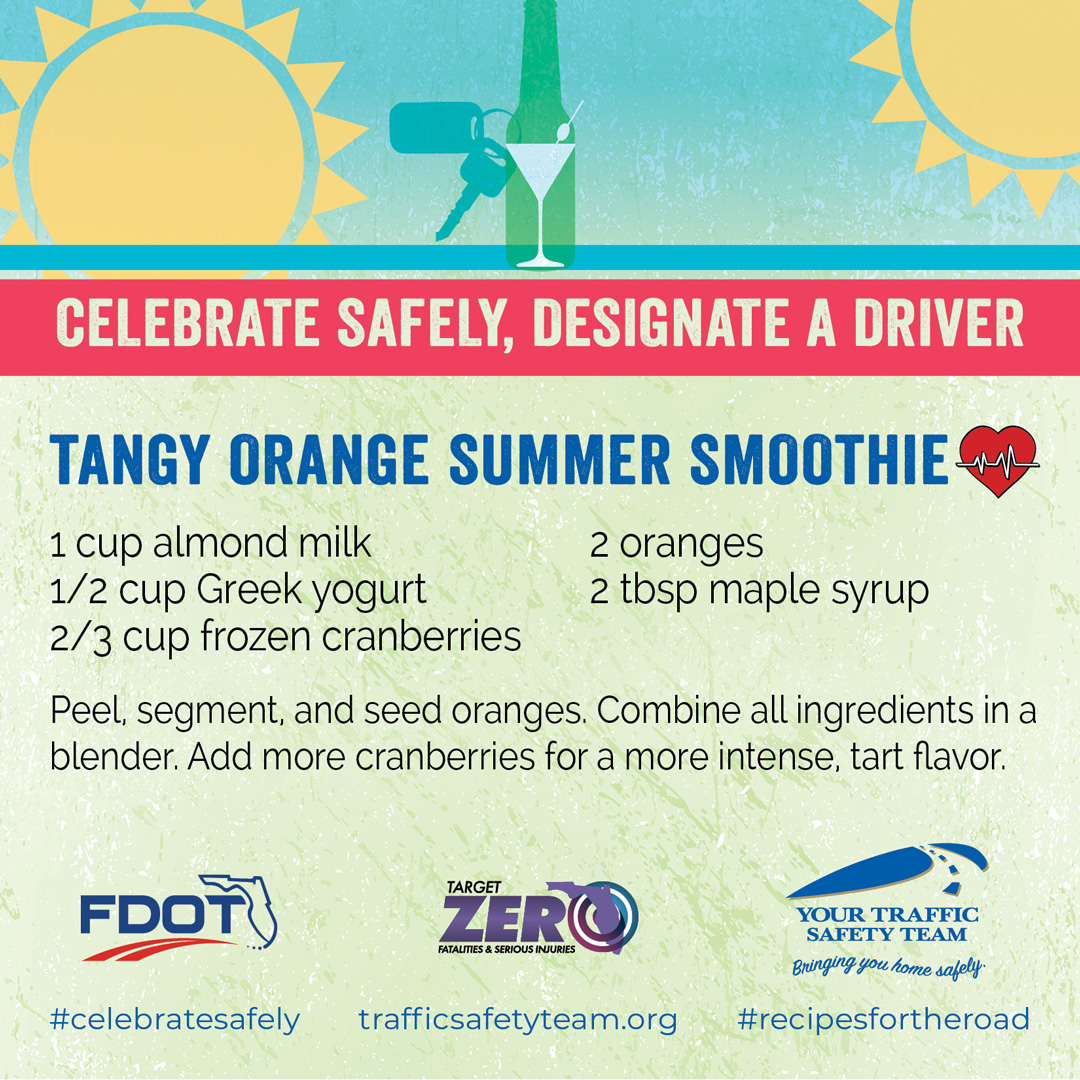
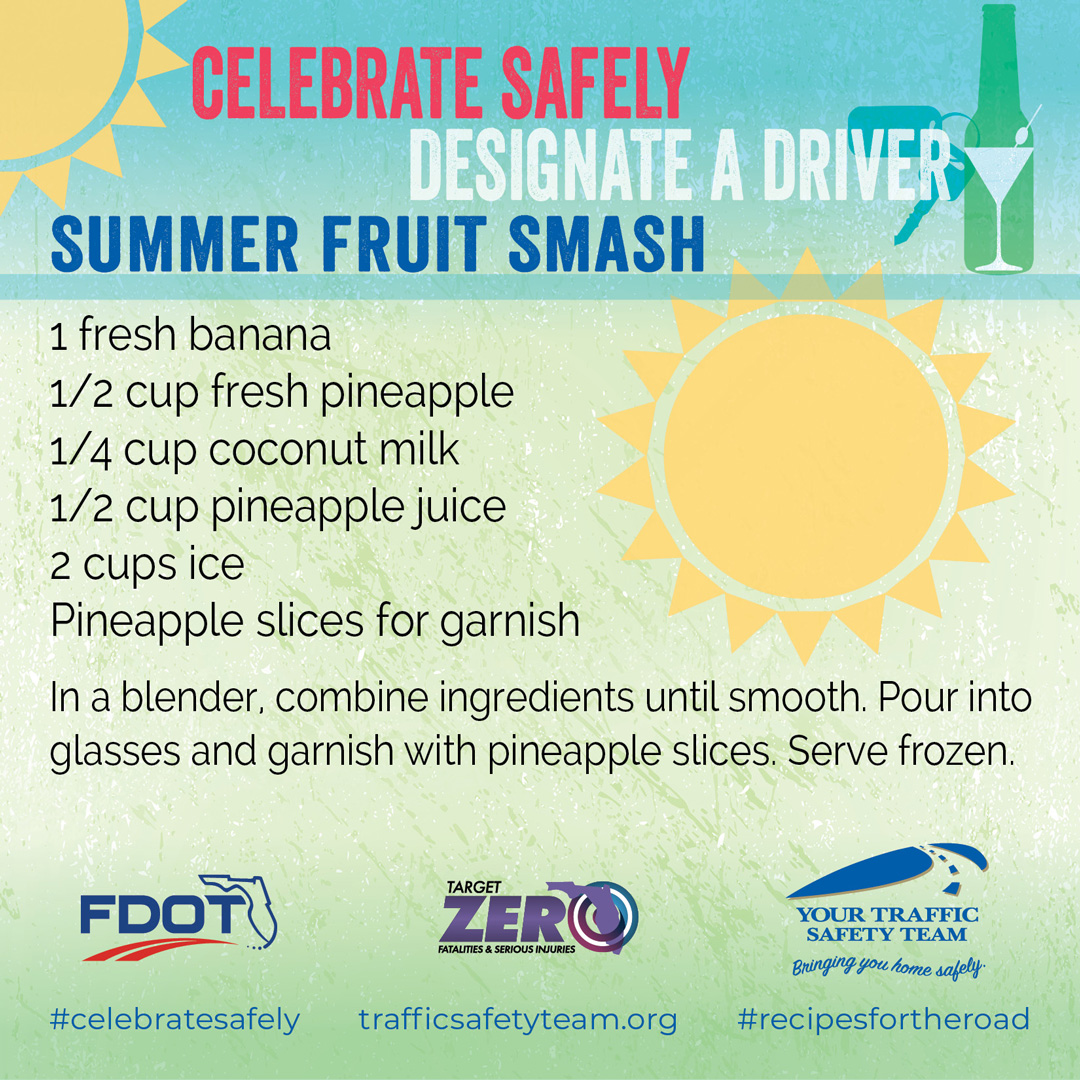
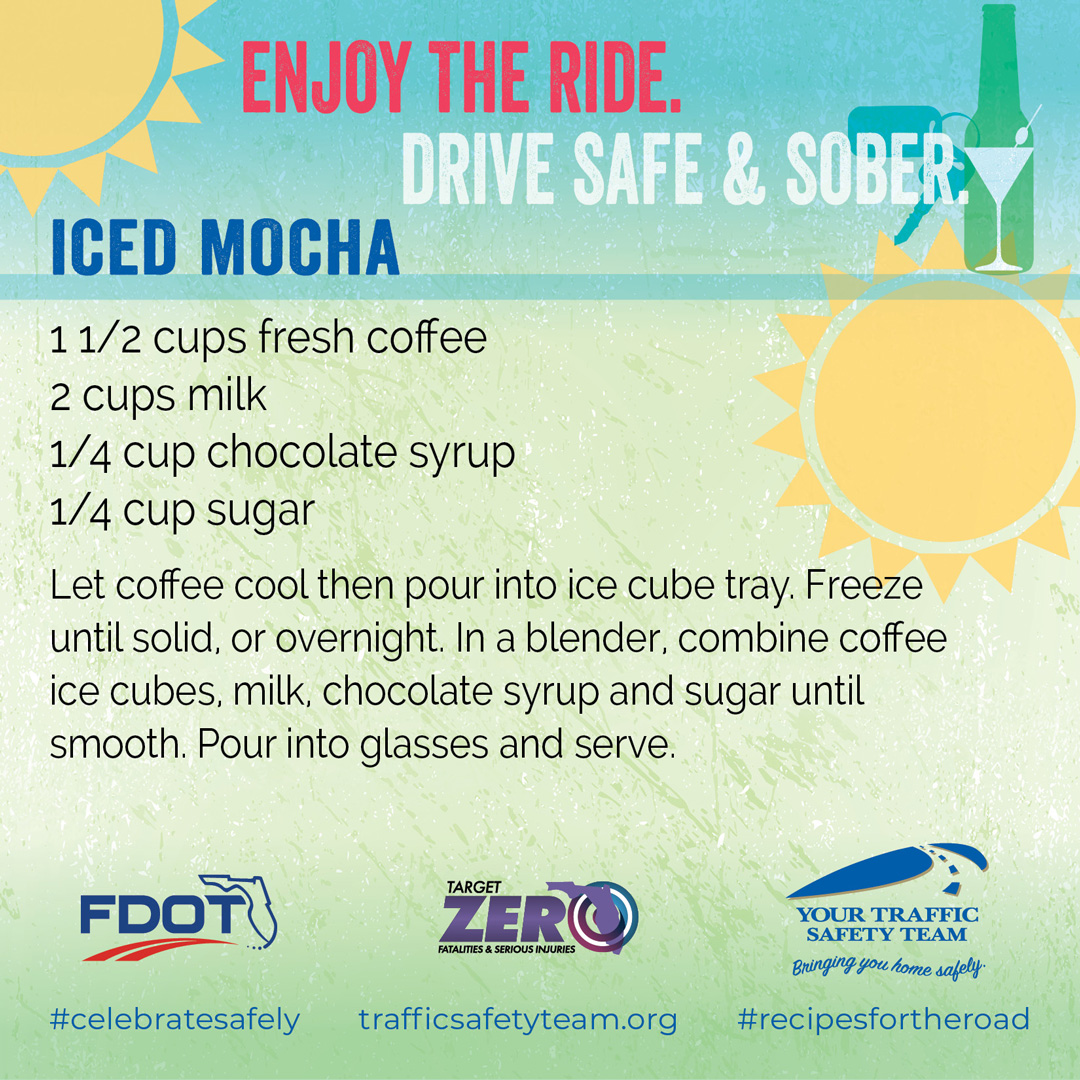
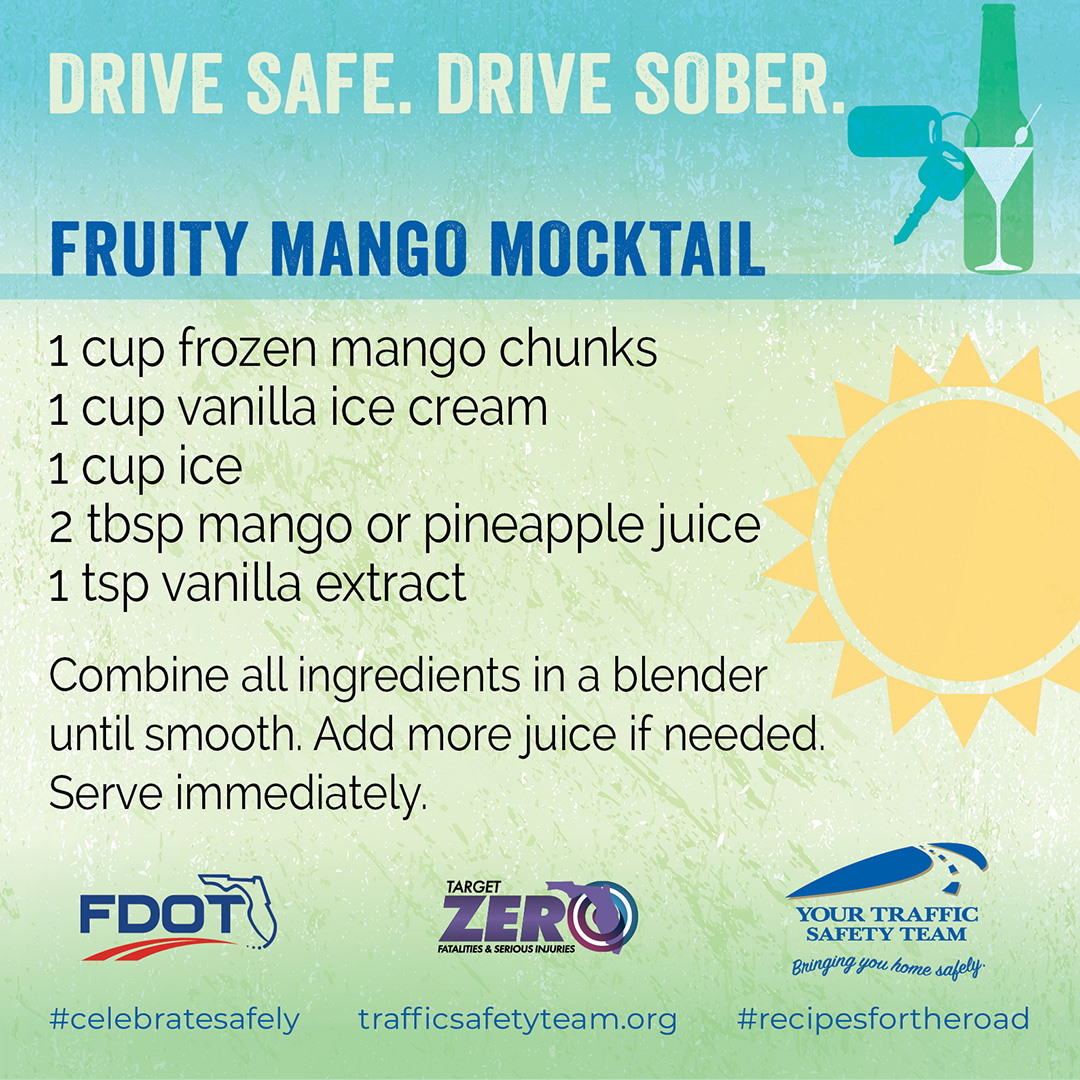
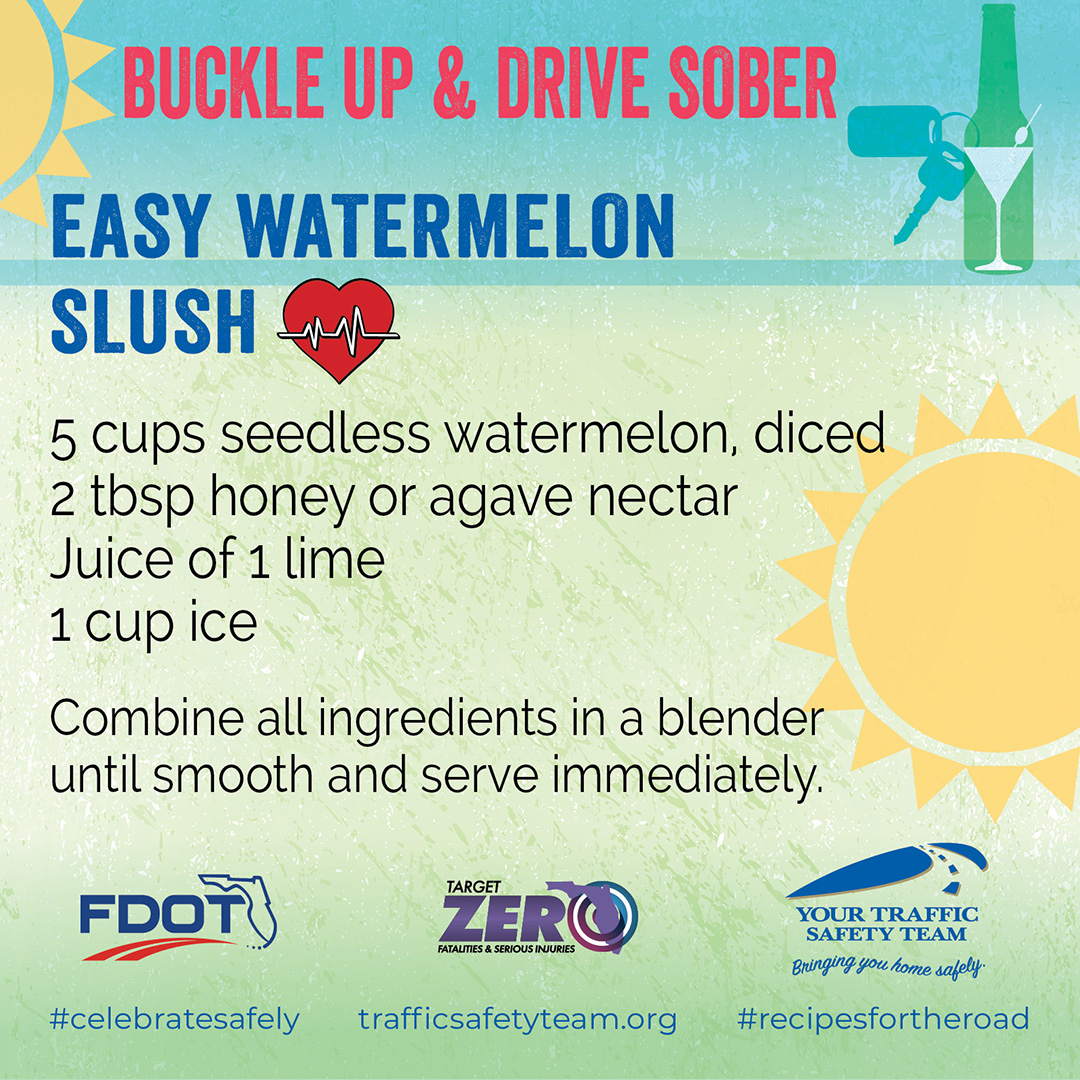
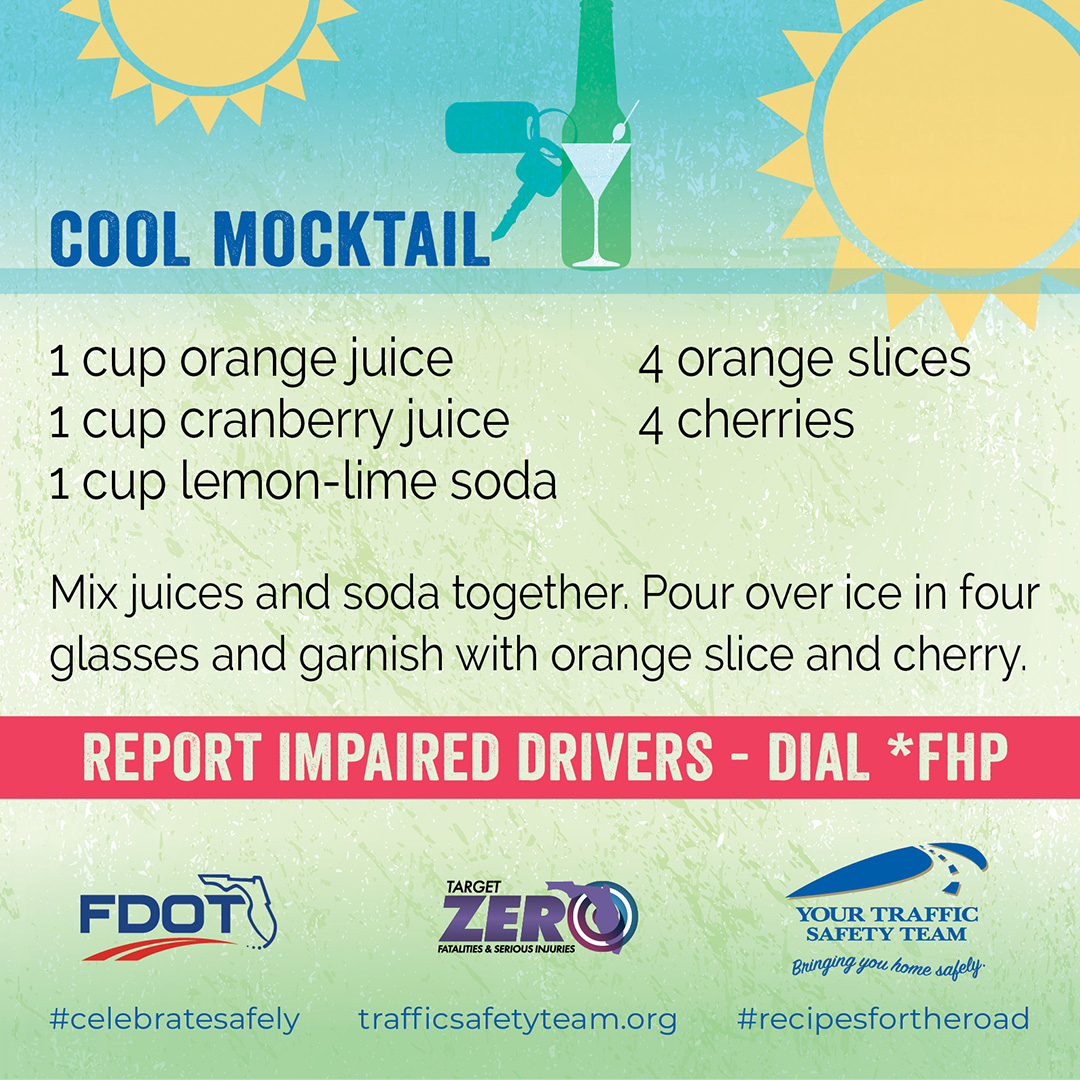
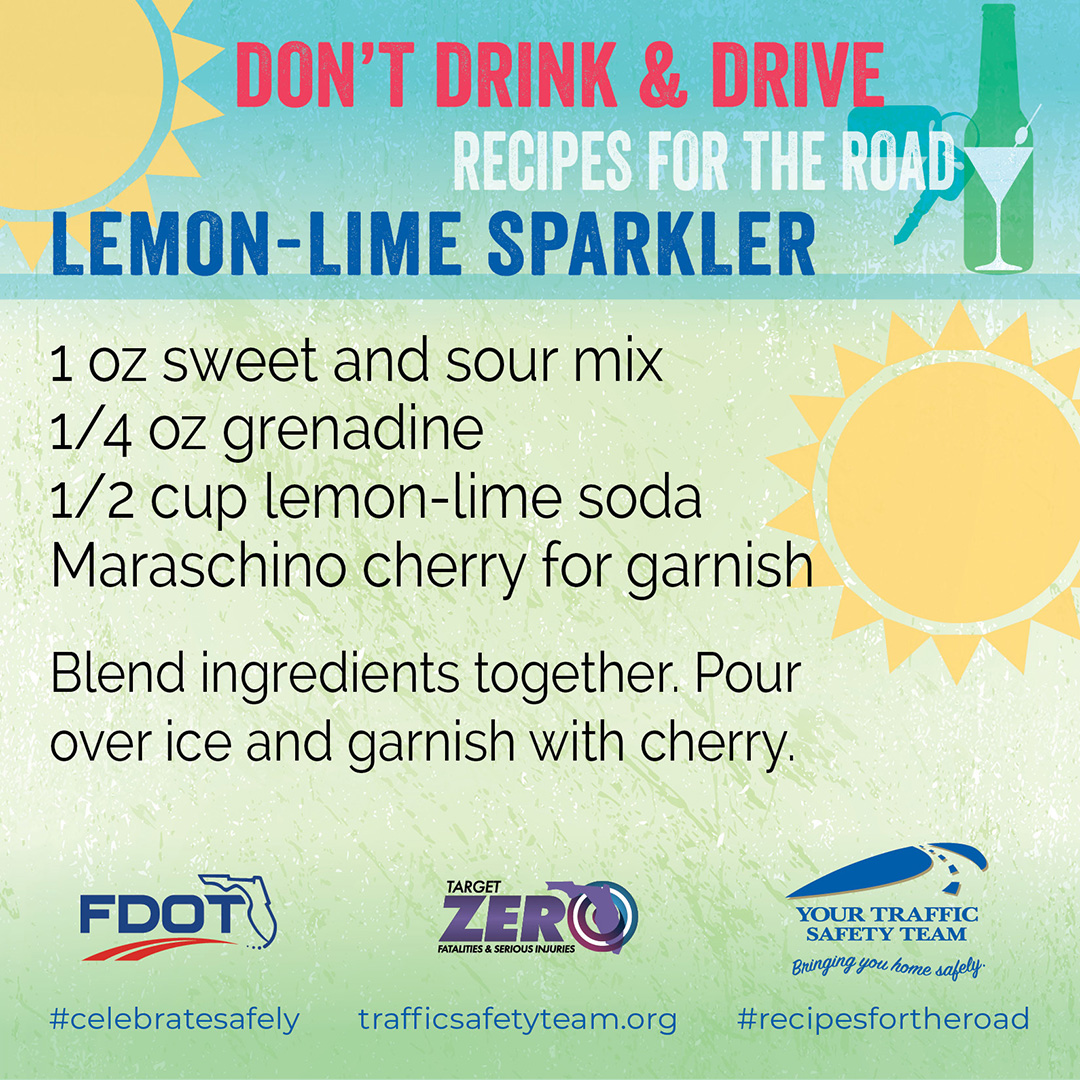
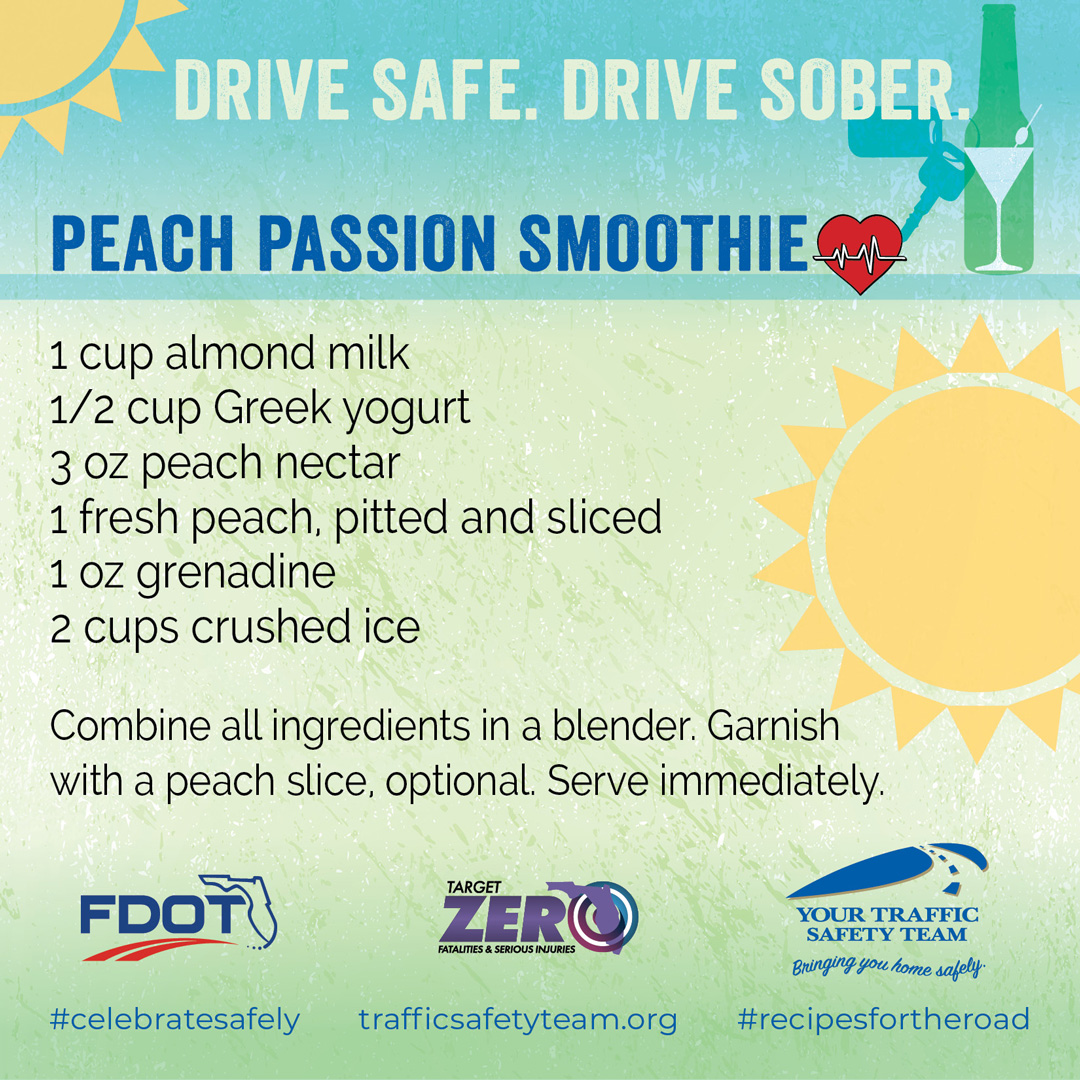
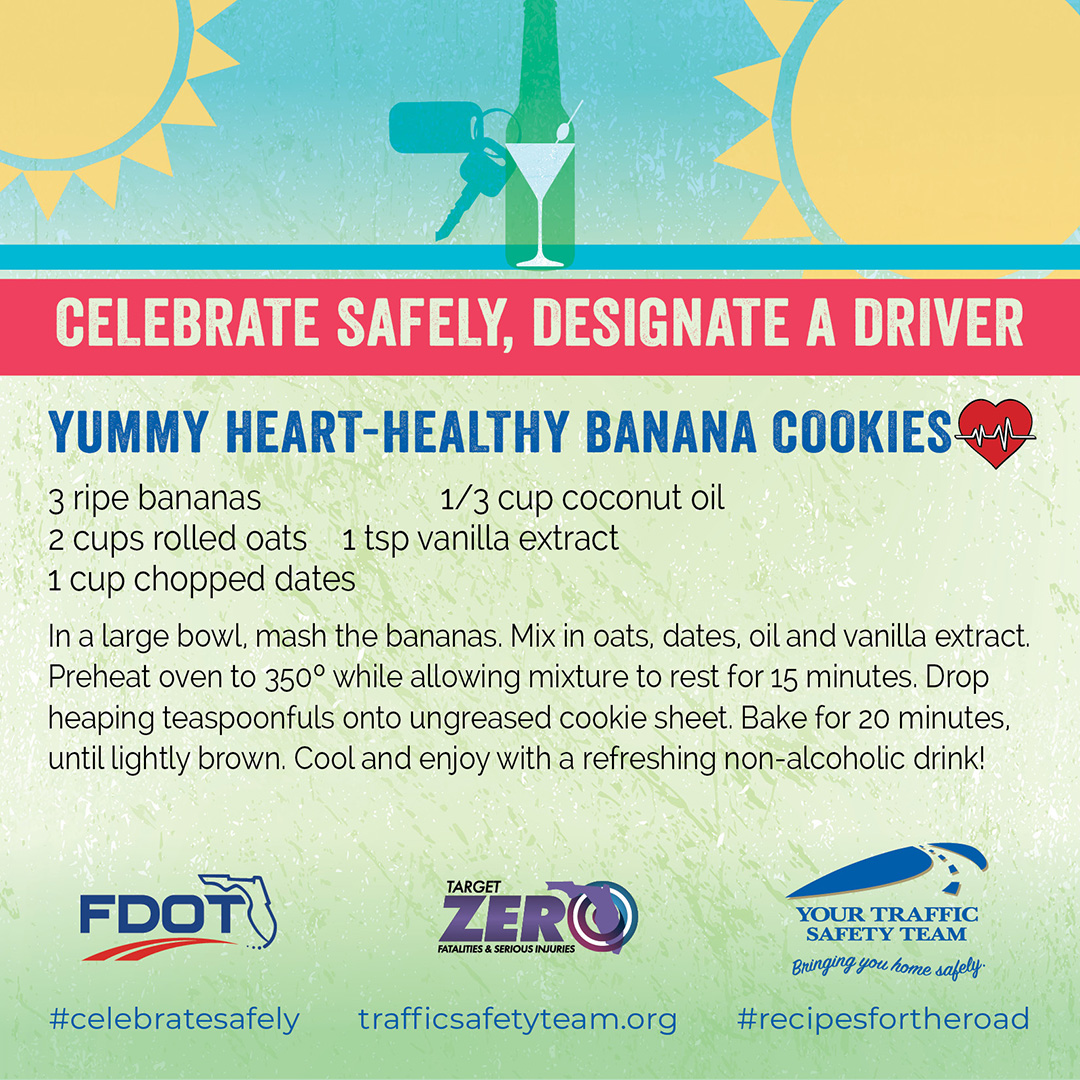
The FDOT District Two Community Traffic Safety Program created a Summer Celebration Safely edition of “Recipes for the Road”

We promote simple safety messages along with delicious, non-alcoholic “mocktail” drink recipes, heart-healthy recipes, and food recipes. Our goal is to promote positive driving behaviors year-round and reduce impaired-driving crashes, injuries, and fatalities on our roadways.

Please help spread the message of celebrating safely with these cool summer “Recipes for the Road.” Download and share these traffic safety tips and recipes. Remember to tag us @trafficsafetyteam on Facebook, Instagram, and YouTube, or @trafficsafetyfl on Twitter and Pinterest. Hashtag #celebratesafely #trafficsafetyteam

Summer Celebrate Safely Digital Recipe Cards:

Click to download and print or post on social media. Provided by FDOT Community Traffic Safety Program.

Recipes For The Road Card

In 2021, we distributed Summer Celebrate Safely “Recipes for the Road” cards printed as double-sided, 5.5″ x 8.5″ handouts in full color. They were available for our Northeast Florida Traffic Safety Team members, partners, organizations, and local communities.

In 2019, there were almost 2,000 reported crashes, with 109 fatalities involving impaired driving throughout the Northeast Florida district. That is 109 deaths that could have been prevented. This summer and throughout the year, remember to celebrate safely always!


Summer Mocktail Recipe Videos:

For more impaired driving information and resources, make sure to check out the following:

Drive safe. Drive sober. If you plan to drink, designate a driver or schedule a cab/ride-share/Uber/Lyft for a safe ride home.

Target Zero and Safe System Approach

The Community Traffic Safety Program is ground ZERO for Target Zero! The Northeast Florida Community Traffic Safety Teams work to connect, interact, plan, design, educate, and solve traffic safety concerns as part of Target Zero.

Ground ZERO for Target Zero

The Florida Department of Transportation is focused on Target Zero and employing the Safe System Approach in plans and projects. Everyone needs to share in the responsibility; everyone has a role!

FDOT District Two’s Community Traffic Safety Program has targeted traffic safety issues in Northeast Florida since 1994. We collaborate and solve local traffic safety concerns through education, enforcement, engineering, and emergency services. Click here to learn more about the CTSP and District Two Community Traffic Safety Teams.

Florida's Target Zero Team poster

TOGETHER TOWARD ZERO

Join Florida’s Target Zero Team. We are asking our network of Community Traffic Safety members and partners to continue their life-saving work and support this initiative. Please click here to download, print, and display this 11×17 poster at your agency to help promote the vision of ZERO.

No Fatality or Serious Injury is Acceptable

Eight people are killed on average, and 49 are seriously injured on Florida’s roads daily. Driver behavior is a contributing factor in most severe and fatal crashes. This initiative focuses on connecting, interacting, and designing our transportation system to specifically relate to motorists most involved in serious injury and fatality crashes.

In Florida, Target Zero builds upon the national Vision Zero belief. Focusing on influencing dangerous driver behaviors before serious and fatal crashes occur. Target Zero aligns resources and establishes actions for all safety partners to take evolutionary steps. Improving how Florida connects, interacts, plans, designs, operates, and maintains its transportation system.

Eliminating roadway fatalities is our highest priority. Of course, we recognize that achieving zero deaths and serious injuries will not be easy and will require commitment, energy, and innovation. Together, we can make progress to achieve our target of ZERO.  

Zero is our goal. A Safe System is how we will get there.

Safe System Approach

The Federal Highway Administration (FHWA) has committed zero deaths by adopting the Safe System Approach to address the high number of severe and fatal injuries resulting from vehicle crashes. This holistic view of the road system anticipates human mistakes. Furthermore, it keeps impact energy on the human body at tolerable levels. Safety is an ethical imperative for everyone, including users, designers, and transportation system owners.

The Safe System Approach is based on six principles:

  • Death and serious injury are not acceptable.
  • Humans make mistakes.
  • Humans are vulnerable.
  • Responsibility is shared.
  • Safety is proactive.
  • Redundancy is crucial.

Five elements that work together for a safer and more accessible transportation system. Reducing severe injuries and fatalities, as a result:

  • Safer Roadways – This includes design and planning to make roadways more forgiving of human mistakes by separating users in time and space. For example, dedicated bicycle lanes or the implementation of pedestrian scrambles. This is where only pedestrians are given dedicated time and space to navigate intersections.
  • Safer Speeds – The magnitude of speed is directly correlated to the survivability of a crash. Mitigation examples include implementing countermeasures such as lane narrowing or speed feedback signage. Designing context-based roadways that set “target speed” goals. If a crash occurs, it is at a speed at which humans can survive.
  • Safer Road Users – This includes ALL road users and encompasses shared responsibility. Users must practice safe behavior, such as using raised medians that protect pedestrians when crossing and make them more visible.
  • Safer Vehicles – Employing safety measures in vehicles that help prevent crashes or reduce the magnitude of a crash. This can reduce fatalities and serious injuries. For example, autonomous braking, lane departure warnings, and driver alcohol detection systems.
  • Post-Crash Care – Ensuring proper emergency response is deployed, and all traffic incident management systems work in unison. Additionally, this includes the integration of emergency vehicle preemption or automatic crash notification systems.

Safe System Approach vs. Traditional Road Safety Practices

Traditional road safety strives to modify human behavior and prevent all crashes. Whereas the Safe System approach also refocuses transportation system design and operation on anticipating human mistakes and lessening impact forces to reduce crash severity and save lives.

Traditional Approach
Prevent crashes
Improve human behavior
Control speeding
Individuals are responsible
React based on crash history
Safe System Approach
Prevent deaths and serious injuries
Design for human mistakes/limitations
Reduce system kinetic energy
Share responsibility
Proactively identify and address risks

Additional information and resources available:

Inclement Weather Safety

Traffic accidents increase during bad weather. Following the inclement weather safety tips below can reduce traffic-related crashes, injuries, and fatalities on our roadways. These traffic safety graphics, video, and safe driving tips can be shared with your organization and community.

Today’s Forecast Calls for a Safe Drive

Sometimes we have the privilege of preparedness; other times Mother Nature mounts a sneak attack and we encounter a bad storm. Remember the saying “Expect the unexpected?” Knowing how to handle your vehicle in dangerous weather will prevent panic when you are forced into driving in a storm.

Become weather-wise by following these simple guidelines:

  • Turn on your lights.
  • Keep windshield wipers on and make sure they are in good working condition.
  • Slow down, but keep moving. Don’t stop unless you can get completely off the road.
  • Minimize lane changing.
  • Stay further back away from the car in front of you.
  • Be careful of large puddles, they can make your brakes less effective.
  • On wet roads, apply brakes smoothly and evenly to avoid hydroplaning. If you do lose control, take your foot off the gas and do not apply the brakes suddenly.
  • Never drive through flood water more than six inches deep. If you encounter a flooded area, turn around. If your car stalls, abandon it immediately and climb to higher ground.
inclement weather safety

Northeast Florida experiences many challenging weather conditions that make it a hazard while driving. Thunderstorms and heavy fog are frequent occurrences. Hurricanes are also a significant concern. High winds, wet roads, and low visibility increase the crash risk. Plan ahead and be prepared for predicted storms and hurricanes. Please drive safely and stay off the road during inclement weather unless it’s an emergency.


Links to Safe Travel Information